
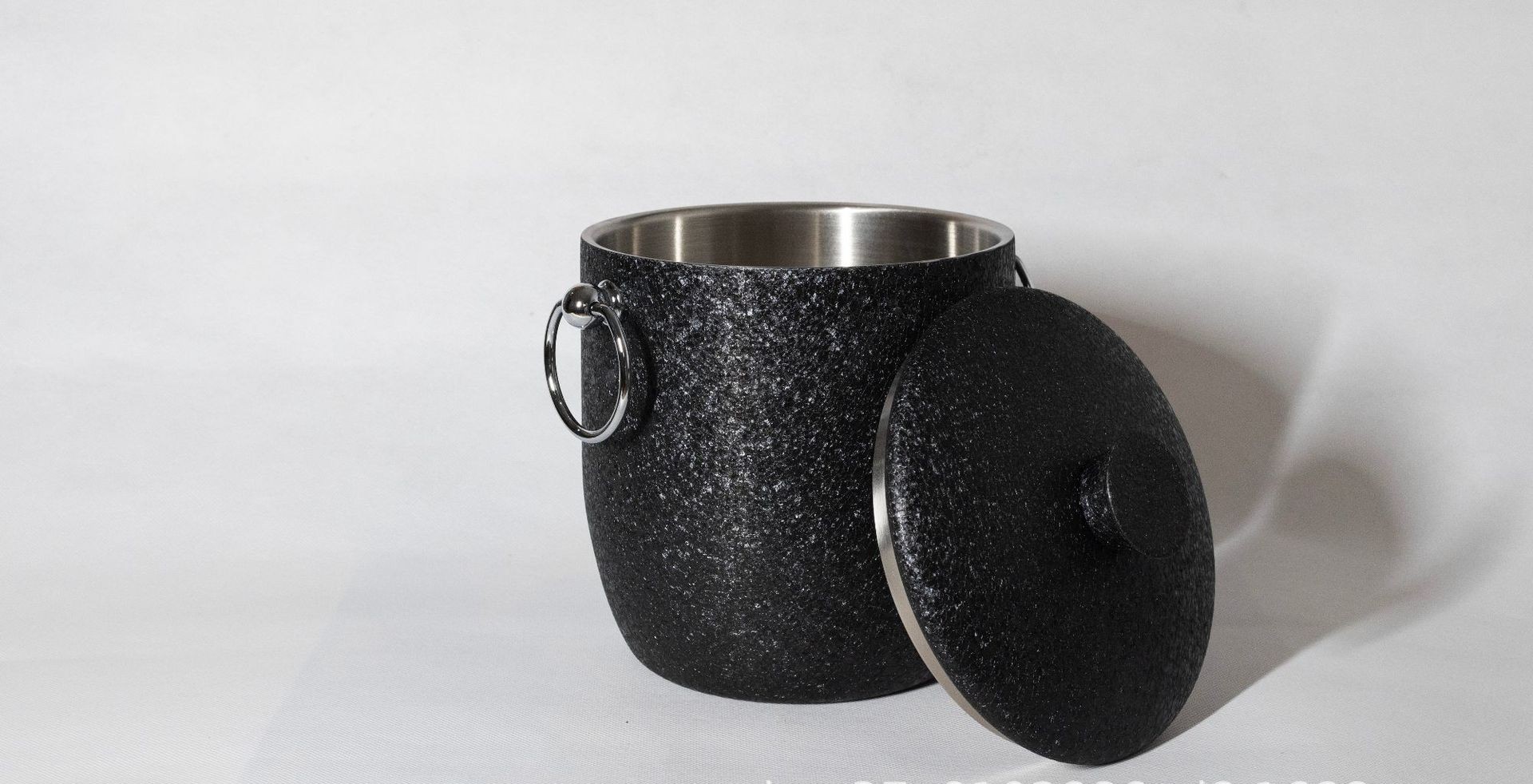
You are planning a party for 30 guests, buying ice by the bag, and hoping it lasts through the evening. Three hours in, the bucket is a pool of water. The drinks are warm. Someone is making an emergency ice run. This scene repeats at backyard barbecues, hotel poolside events, bar openings, and wedding receptions — and the fix is not more ice. It is a better bucket.
As a stainless steel drinkware manufacturer in Yongkang, China, we produce insulated ice buckets for brands, hotels, bars, and event companies across 40+ countries. This guide covers exactly what we tell our wholesale buyers when they ask: which insulated ice bucket for a party is actually worth the money, and how do I choose the right one?
Why Insulation Type Is the Single Biggest Decision
Not all “insulated” ice buckets deliver the same performance. The market has three fundamentally different constructions, and the gap between them is enormous:
| Construction Type | How It Works | Ice Retention (25°C Room) | Ice Retention (30°C+ Outdoor) | Condensation | Wholesale Cost (3L) |
|---|---|---|---|---|---|
| Double-wall vacuum | Two 304 SS walls with vacuum-sealed gap; copper plating on inner wall reflects radiant heat | 18-24+ hours | 8-12 hours | Zero (exterior stays dry) | $9.00-$14.00 |
| Foam-insulated (double-wall) | Two walls with polyurethane foam injected between them | 6-10 hours | 3-5 hours | Minimal | $6.00-$9.00 |
| Single-wall stainless steel | One layer of 304 SS, no insulating layer | 4-6 hours | 1.5-3 hours | Heavy (drips constantly) | $4.80-$8.00 |
| Plastic (PP/acrylic) | Molded plastic, single or double wall | 2-4 hours | 1-2 hours | Heavy | $1.50-$4.00 |
The data is from our Yongkang factory QC lab, testing 1 kg of ice cubes per container with the lid sealed. The double-wall vacuum bucket retains ice 6-8 times longer than plastic — that is not a marginal upgrade. It is the difference between a host who relaxes and one who spends the party running to the freezer.
Our recommendation: for any event lasting more than 2 hours, double-wall vacuum insulation is the only construction worth buying. For a quick drink station under 90 minutes, single-wall stainless steel is acceptable. Plastic works only for disposable, single-use situations.
Capacity Guide: Match the Bucket to the Party Size
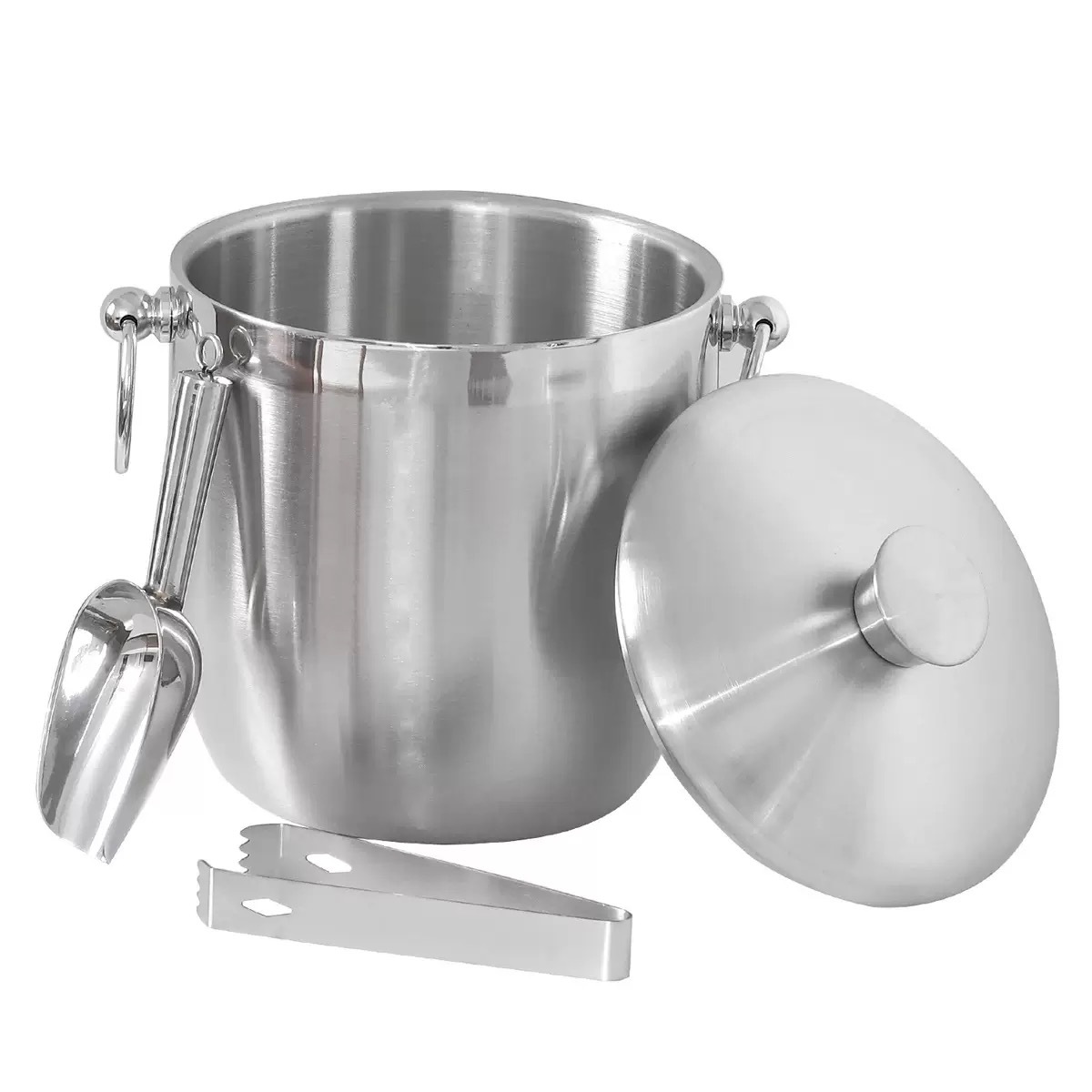
The most common mistake event planners make is buying one bucket that is too small instead of multiple buckets at the right size. Here is our capacity guide based on data from hotel and catering clients:
| Capacity | Ice Load | Best For | Guests Served | Refill Frequency (Vacuum) |
|---|---|---|---|---|
| 1.5L (50oz) | ~1.2 kg | Hotel room service, bedside table, intimate dinner for 2 | 2-4 | Every 18-24 hours |
| 3L (100oz) | ~2.5 kg | Home bar, cocktail party, restaurant table service | 6-10 | Every 12-18 hours |
| 5L (170oz) | ~4 kg | Bar counter, medium event station, champagne service | 10-20 | Every 8-14 hours |
| 8L (270oz) | ~6.5 kg | Catering station, outdoor wedding, large event | 20-35 | Every 6-10 hours |
| 12-20L (3-5 gal) | ~10-16 kg | Beverage tub, festival bar, commercial self-serve | 35-60+ | Every 4-8 hours |
The rule for large parties: multiple smaller buckets always beat one giant tub. A 50-person wedding is better served by five 5L insulated buckets placed at separate stations than a single 25L beverage tub. You get better ice retention (smaller buckets have better lid-seal ratios), shorter guest lines, and the buckets double as table decor when powder coated in your event colors.
Material Deep Dive: Stainless Steel vs Plastic vs Copper
The bucket material affects ice retention, durability, appearance, food safety, and your total cost of ownership over multiple events:
18/8 Stainless Steel (304 Grade) — The Industry Standard
This is what we manufacture and what we recommend for 95% of applications. 304 stainless steel contains 18% chromium and 8% nickel, making it corrosion-resistant, food-safe, and able to withstand years of salt-water ice contact without pitting. The thermal conductivity of stainless steel is 16 W/m·K — low enough to limit heat transfer in single-wall configurations, and irrelevant once you add vacuum insulation (which drops effective thermal transfer to near zero).
Key specifications for wholesale buyers:
- Inner wall: 0.5mm 304 SS, copper-plated on premium models for radiant heat reflection
- Outer wall: 0.5-0.6mm 304 SS, powder-coated or mirror-polished
- Weight: 3L bucket approximately 800g, 5L approximately 1.1 kg
- Lifespan: 10+ years with normal use; no degradation in ice performance over time
Plastic (PP, Acrylic, Polycarbonate)
Plastic buckets cost 60-75% less than stainless steel. That is their only advantage. Disadvantages: cannot be vacuum insulated (the material cannot hold a vacuum seal), cracks under UV exposure at outdoor events, absorbs odors and stains over time, and looks cheap on a catered table. Acrylic is transparent (good for display) but scratches easily and shatters if dropped on tile. For a one-time house party, plastic works. For any business buying ice buckets as an asset — hotels, bars, caterers, event rental companies — plastic is a false economy.
Copper and Copper-Plated
Solid copper ice buckets look stunning and have excellent thermal conductivity (385 W/m·K) — which is actually a disadvantage for ice retention, because heat from the room transfers into the ice faster. Copper buckets are chosen for aesthetics, not performance. They require polishing, tarnish in humid environments, and cost 3-4x more than stainless steel. Our recommendation: if you want the copper look, choose a stainless steel bucket with copper-tone powder coating — identical visual effect, superior ice retention, zero maintenance.
What to Look for Beyond Insulation and Material
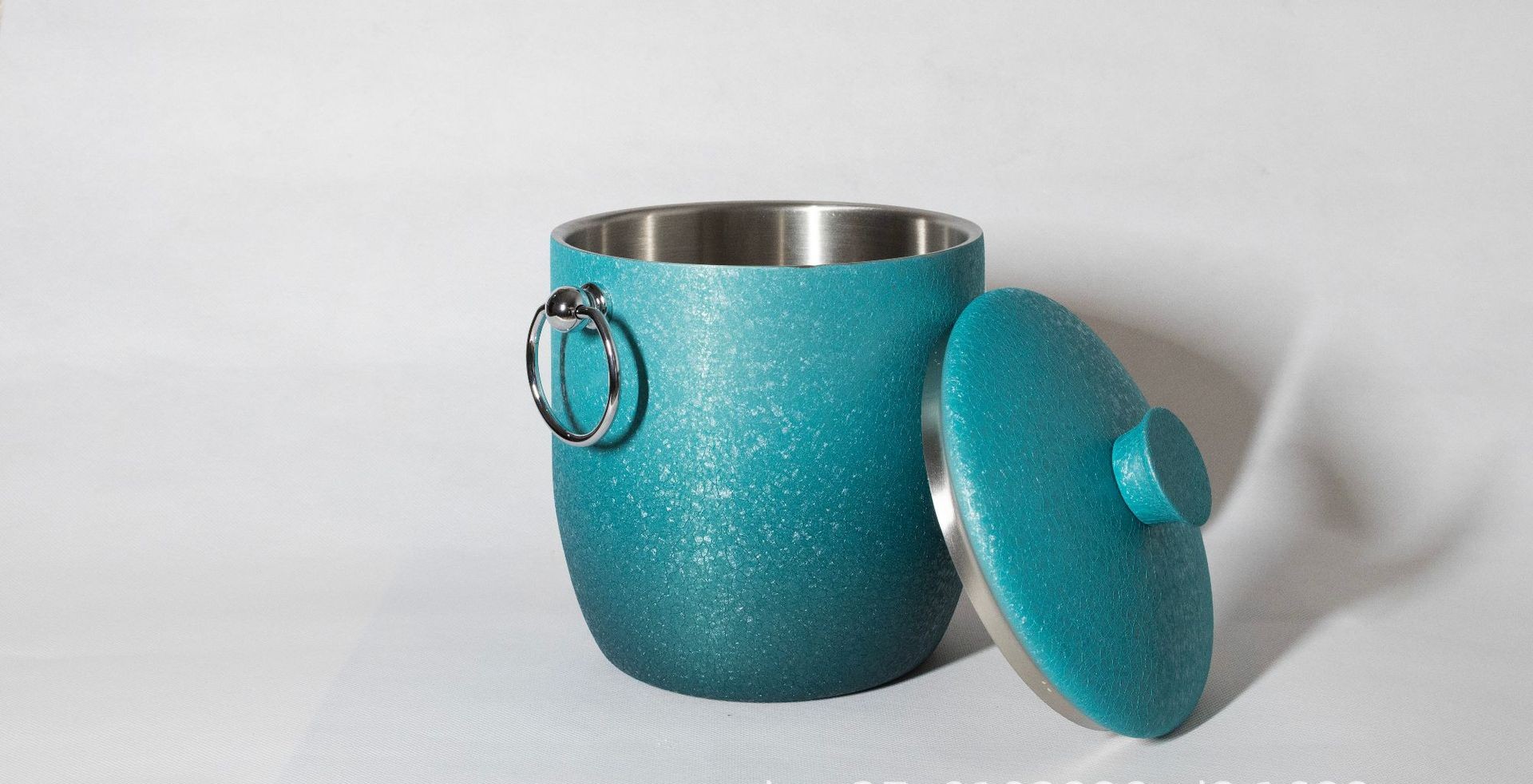
Once you have decided on double-wall vacuum stainless steel (which you should), these secondary features determine whether the product works well at a real event:
Insulated lid with gasket. Up to 40% of heat enters through the top opening. A lid with a silicone gasket seal extends ice retention by 30-50% versus an open bucket. Our lids are also double-walled, adding an additional insulating barrier. For self-serve stations, choose a lid with a slide-open section so guests do not remove the entire lid.
Drain insert (strainer). A perforated stainless steel insert elevates the ice above meltwater. If ice sits in its own meltwater, the water (which is warmer than 0°C) accelerates melting of the remaining cubes. The drain insert extends useful ice time by 15-20%. All our 3L, 5L, and 8L sets include this component.
Tongs and scoop. For food-safety compliance at commercial events, guests and staff should never reach into the ice with their hands. Bundled tongs save the buyer from sourcing them separately. Our 3L set includes matching 304 SS tongs; the 5L and 8L models include an ice scoop.
Double handles. Critical for 5L+ sizes. A loaded 8L ice bucket weighs approximately 7.5 kg. Welded stainless steel handles (not riveted — rivets loosen over time) allow safe two-handed carrying.
Non-slip base. A silicone ring on the base prevents the bucket from sliding on wet bar surfaces, granite countertops, or glass tabletops. This is a detail most retail buyers do not think about until a full bucket slides off a table at an event.
Wholesale Pricing: What Insulated Ice Buckets Actually Cost
Transparent factory-direct pricing from our Yongkang production facility (FOB Ningbo, 2026):
| Model | 100-499 pcs | 500-999 pcs | 1,000+ pcs |
|---|---|---|---|
| 3L Vacuum Set (bucket + lid + tongs + drain) | $12.00-$14.00 | $10.50-$12.00 | $9.00-$10.50 |
| 5L Commercial (bucket + lid + scoop) | $16.00-$18.00 | $14.00-$16.00 | $12.00-$14.00 |
| 8L Event (bucket + lid + scoop + handles) | $22.00-$26.00 | $19.00-$22.00 | $16.00-$19.00 |
| Single-wall SS 3L (bucket only, no vacuum) | $6.50-$8.00 | $5.50-$6.50 | $4.80-$5.50 |
Prices include powder coating in stock colors, all included accessories, and individual box packing. Add-ons: laser engraving $0.50-$0.80/pc, UV full-color printing $0.80-$1.20/pc, custom Pantone color matching $0.30-$0.50/pc (500 pc minimum for custom colors). MOQ: 100 pieces per model.
Retail margin context: our wholesale 3L vacuum ice bucket set at $10.50 retails on Amazon and DTC websites for $38-$55 — a healthy 3.5-5x markup. The 8L event model retails for $65-$95. These are high-perceived-value products because consumers associate stainless steel + vacuum insulation with premium brands like YETI and RTIC.
Choosing by Use Case: Who Buys What
After manufacturing ice buckets for 400+ wholesale clients, here is what each buyer segment actually orders:
Home and kitchen brands (Amazon, Shopify, DTC): The 3L vacuum set is the best seller — it covers the widest consumer use case (home bar, kitchen counter, dinner party). Powder coated in Matte Black, White, or Rose Gold. Retail price point $38-$55. These buyers order 500-2,000 units per shipment and reorder quarterly.
Hotels and resorts: 1.5L for in-room ice service (guest rooms, minibars), 3L for poolside and lobby bar. Custom laser-engraved with the hotel name and crest. Typical order: 200-500 units. Replacement cycle: every 2-3 years. Hotels care most about condensation-free exteriors (no water rings on wooden furniture) and quiet, non-rattling lids.
Bars and restaurants: 3L for tableside champagne and wine chilling, 5L for behind-bar ice stations. Mirror-polished or custom color-matched to the bar interior. Bartenders prioritize wide-mouth openings for quick scooping and durable construction that survives being knocked around during a busy service.
Event and catering companies: 5L and 8L models with double handles for transport. Branded with the company logo. These buyers need stackable designs for storage between events. Our 5L and 8L models nest inside each other, reducing warehouse footprint by 40%.
Corporate gift distributors: 3L ice bucket gift sets (bucket + tongs + bottle opener in a presentation box). Powder coated in the client’s brand color with laser-engraved logo. Popular for executive gifts, real estate closing gifts, and holiday client appreciation. These buyers order 100-300 sets, often with a tight deadline around Q4 gifting season.
5 Setup Tips That Maximize Ice Retention at Any Party
Even with the best insulated ice bucket, proper setup extends ice life by 30-50%:
1. Pre-chill the bucket for 5 minutes. Fill with ice water, let the inner wall temperature drop to near-freezing, then drain and refill with fresh ice. This prevents the first batch of ice from sacrificing itself to cool down the steel walls.
2. Use large cubes or block ice. Larger pieces have less surface area relative to volume — a single ice block melts 3x slower than the same weight in cocktail cubes. For display events, clear block ice inside an insulated bucket creates a striking visual.
3. Keep the lid sealed between servings. Every lid-off moment lets warm air rush in. For self-serve stations, use a bucket with a slide-opening lid so the entire top is never exposed. Our lids with gasket seals reduce heat entry by up to 40%.
4. Position in shade. Direct sunlight adds significant radiant heat — moving the bucket from sun to shade extends ice life by 25-30% at an outdoor event. Place under a canopy, umbrella, or tent awning.
5. Do not drain meltwater. This is counterintuitive, but the cold meltwater sitting at the bottom actually insulates the remaining ice. Draining it exposes more ice surface area to warm air. The drain insert keeps ice elevated above the water while the water pool stays cold below.
How We Manufacture Insulated Ice Buckets
Understanding the production process helps wholesale buyers evaluate quotes and ask the right factory questions:
Step 1: Deep drawing. Flat 304 stainless steel sheet (0.5mm inner, 0.6mm outer) is drawn into cup shapes by hydraulic press. Each wall is formed separately.
Step 2: Copper plating (premium models). The inner wall receives an electroplated copper layer that reflects infrared radiation, reducing radiant heat transfer by 10-15%.
Step 3: Vacuum sealing. The inner and outer walls are welded at the rim, then the air between them is evacuated through a small port, which is sealed with a getter material that absorbs residual gas molecules. This vacuum gap is the core technology — it eliminates conduction and convection between walls.
Step 4: Leak and vacuum testing. Every bucket is submerged in hot water to check for air bubbles (indicating a seal failure) and then tested with a helium leak detector. Failed units are rejected. Our pass rate is 98.5%.
Step 5: Powder coating or polishing. The outer wall is sandblasted, primed, and electrostatically coated with thermoset powder, then cured at 200°C. The result is a chip-resistant, UV-stable finish available in 50+ colors. Mirror-polished models skip this step and receive a multi-stage mechanical polish instead.
Step 6: Assembly and QC. Lid gasket installation, accessory bundling (tongs, scoop, drain insert), and final quality inspection per AQL 2.5 sampling. Packed in individual retail-ready boxes or bulk cartons per buyer specification.
Insulated Ice Bucket vs Party Cooler: When to Use Which
A common question from event planners: should I buy insulated ice buckets or a large party cooler? The answer depends on the event format:
Use insulated ice buckets when: drinks are displayed and served at stations (wine, champagne, craft cocktails), the setup needs to look elegant (weddings, corporate events, hotel service), guests serve themselves from a tabletop, or the ice needs to stay presentable for 4+ hours.
Use a party cooler or beverage tub when: you need to chill 30+ cans of beer or soda in bulk, the setting is casual (tailgate, beach party, backyard BBQ), presentation is less important than raw capacity, or the bucket will sit on the ground rather than a table.
Best practice for large events: use both. A large cooler for back-of-house bulk beverage storage, and insulated ice buckets at each guest-facing serving station. Many of our hotel and catering clients order a mix of 3L buckets for front-of-house and 8L buckets for kitchen and bar prep areas.
Related Guides
- Best Ice Bucket for Parties: 12-Hour Melt Test Data — real melt-time data comparing 4 types of party ice containers
- How to Keep Ice from Melting — the physics of heat transfer and 6 tips for maximum ice retention
- Custom Barware Wholesale — cocktail shakers, shot cups, and ice buckets for bar equipment sourcing
- Vacuum Insulation Technology Explained — the science behind why double-wall keeps ice 8x longer
- Browse All Insulated Ice Buckets — full product catalog with specs and pricing