
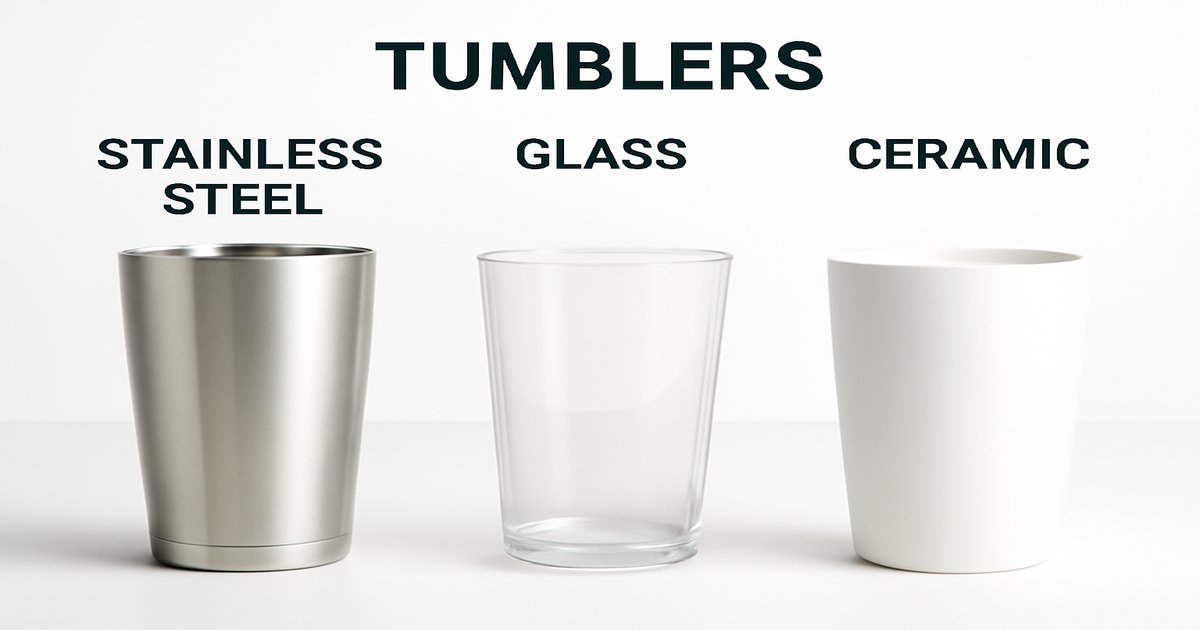
Choosing the right material for your tumbler is the single most important decision that affects performance, price, durability, and customer satisfaction. Glass, stainless steel, and ceramic each have distinct advantages — and the best choice depends entirely on your target market and use case. This guide compares all three materials across every dimension that matters for wholesale buyers and consumers.
The Complete Material Comparison
| Factor | Glass | Stainless Steel | Ceramic |
|---|---|---|---|
| Insulation | None (single-wall) or minimal (double-wall) | Excellent (24hr cold, 12hr hot) | Poor (15-20 min) |
| Durability | Breakable | Nearly indestructible | Breakable, chips |
| Weight (12oz) | 250-400g | 200-350g | 300-500g |
| Taste Neutrality | Best | Excellent | Very good |
| Dishwasher Safe | Yes (borosilicate) | Body: no; Lid: yes | Yes |
| Microwave Safe | Yes | No | Yes (if no metal) |
| FOB Price Range | $1.50 - $4.00 | $2.50 - $7.00 | $0.80 - $3.00 |
| Best Market | Home, office, premium cafe | Travel, outdoor, fitness, gift | Home, gift, promotional |
Glass Tumblers: The Aesthetic Choice
Glass tumblers appeal to design-conscious consumers who prioritize the drinking experience. Borosilicate glass (the same material used in laboratory equipment) is the standard for quality glass drinkware. It resists thermal shock — you can pour boiling water into a cold glass tumbler without it cracking — and is more durable than regular soda-lime glass.
The primary advantage of glass is complete taste neutrality. Glass does not react with any beverage, making it the preferred material for wine, craft beer, and specialty coffee where flavor preservation matters. It is also transparent, allowing consumers to see their drink, which adds to the aesthetic experience.
The limitations are obvious: glass breaks. For home and office use, this is manageable. For travel, outdoor activities, or kids, it is a dealbreaker. Silicone sleeves help with grip and impact absorption but cannot prevent breakage from significant drops.
Stainless Steel Tumblers: The Performance Leader
Stainless steel is the dominant material in the tumbler market for good reason. Double-wall vacuum insulation keeps cold drinks cold for 24+ hours and hot drinks hot for 12+ hours — a performance level that glass and ceramic simply cannot match. Combined with near-indestructibility, stainless steel tumblers are the practical choice for active lifestyles.
The two main grades used in drinkware are 304 (18/8) and 316 (18/10). Both are food-safe, corrosion-resistant, and do not affect beverage taste. 316 grade adds molybdenum for enhanced corrosion resistance and is preferred for kids products and acidic beverages. At Hongming, we use 304 for standard tumblers and 316 for our premium and kids lines.
The stainless steel tumbler market has evolved far beyond simple cylinders. Today's designs include handles, straw lids, flip-open mechanisms, powder-coated finishes in dozens of colors, and printing methods that produce photographic-quality graphics. This customization potential makes stainless steel the most versatile material for branded drinkware.
Ceramic Tumblers: The Classic
Ceramic mugs and cups remain the default drinkware in homes and offices worldwide. They are inexpensive to manufacture, microwave and dishwasher safe, and available in virtually unlimited colors and glazes. For promotional products, custom ceramic mugs offer the lowest cost per impression in the drinkware category.
However, ceramic has significant limitations as a tumbler material. It provides no insulation — coffee cools to room temperature in 15-20 minutes. It is heavy and fragile. And it cannot be sealed with a leak-proof lid in the way that stainless steel tumblers can, making it unsuitable for travel use.
Ceramic's strength is in the home and office gift market, where its traditional aesthetic, microwave compatibility, and low price point make it an enduring choice. For anyone seeking insulation, portability, or durability, stainless steel is the superior option.
Which Material Should You Source?
The answer depends on your target market. If you sell to travelers, commuters, fitness enthusiasts, or outdoor consumers — stainless steel is the clear winner. If you sell to home decor retailers, cafe merchandise programs, or design-focused gift markets — glass or ceramic may be the better fit. For the broadest wholesale appeal and highest margin potential, insulated stainless steel tumblers are the dominant choice in the current market.
Hongming manufactures premium 304 and 316 stainless steel tumblers from our Yongkang factory, with full customization options including powder coating, UV printing, laser engraving, and custom packaging.
Get a quote on stainless steel tumblers — tell us your target market and we will recommend the best products for your needs.