
Quick answer: A well-made powder-coated stainless tumbler can be dishwasher safe. YETI and Hydro Flask both label their current powder-coated products that way. But Hydro Flask excludes its pre-2020 bottles, and its warranty does not cover dishwasher defects under a coating that was already chipped. The difference is not the steel. It is the cure of the coat, the decoration on top of it, the lid plastic and the base seal. If you are putting "dishwasher safe" on your box or your Amazon listing, you need a test behind it. EN 12875-1 is the reference method, run at a cycle count you choose (commonly 125, 250 or 500). This guide covers what fails first, how the test works and what to put in your PO.
We write this from the factory side. When a consumer complains that "the paint came off in the dishwasher", the return lands on the brand, and the brand's first question is what the factory tested. Here is how to answer that before you place the order.
Why "Dishwasher Safe" Is a Brand Claim, Not a Material Property
Steel does not care about your dishwasher. 18/8 (304) stainless handles standard detergent fine, and 316 copes better with the chloride in some commercial detergents, as we cover in our 304 vs 316 stainless steel guide. What fails is everything added to the steel: the coating, the print, the lid, the gasket and the base cap.
That makes "dishwasher safe" a claim about one specific assembly, not something a material either has or doesn't:
- Same tumbler, different decoration, different answer. A plain powder-coated body might pass 500 cycles, while the same body with a UV-printed logo shows fading at the print edges much earlier.
- Same tumbler, different lid, different answer. A PP lid and a clear AS (SAN) lid behave differently in hot alkaline detergent. Clear styrenic lids tend to cloud or craze over repeated cycles.
- Your name is on it. In the US, the FTC's advertising substantiation policy expects objective claims to have a reasonable basis before they are made. "Dishwasher safe" is an objective claim. If you print it, keep the test report in your files.
So the useful question for a buyer is not "is powder coat dishwasher safe?" It is "has this SKU, with this decoration and this lid, been tested, and for how many cycles?"
What a Dishwasher Does to a Tumbler
A domestic dishwasher combines three stresses at the same time, and that combination is why coatings that pass a simple hot-water soak can still fail in a machine:
| Stress | Typical level | What it attacks on a tumbler |
|---|---|---|
| Heat | Main wash roughly 60-70°C (140-160°F), plus a heated dry phase | Lid plastics, silicone gaskets, adhesives, ink binders. Not the powder coat itself, which is cured at far higher temperatures (around 180-200°C) |
| Chemistry | Strongly alkaline detergent, often with bleach or enzymes | Under-cured or poorly pretreated coatings (chalking, gloss loss), UV inks, sublimation polymer coats |
| Mechanics | High-pressure spray, parts knocking against the rack | Coating edges at the rim and base, laser-engraved edges, anywhere the coat is already chipped |
That is why the fastest lab method, EN 12875-4, immerses articles in an alkaline detergent solution at 75 ± 1 °C. Heat plus alkali is the combination that separates a good coating from a weak one.
What Fails First: A Failure Timeline by Component
When tumblers come back with a dishwasher complaint, the part that failed almost always tells you what went wrong. Here is the typical order, from first to last:
| Component | Typical failure | When it usually shows up | Root cause to check with the factory |
|---|---|---|---|
| Vinyl / water-slide decal | Edges lift, then peel | First few cycles | Not suitable for dishwasher. Label it hand wash |
| Sublimation coating | Dulling, colour shift | Tens of cycles | Polymer coat type and thickness, press temperature |
| UV print | Fading at print edges, ink rub-off | Low hundreds of cycles without a clear coat | UV cure dose, adhesion promoter, protective clear coat |
| Clear AS / SAN lid | Clouding, fine cracks (crazing) | Tens to hundreds of cycles | Resin choice. PP or Tritan copolyester usually hold up better |
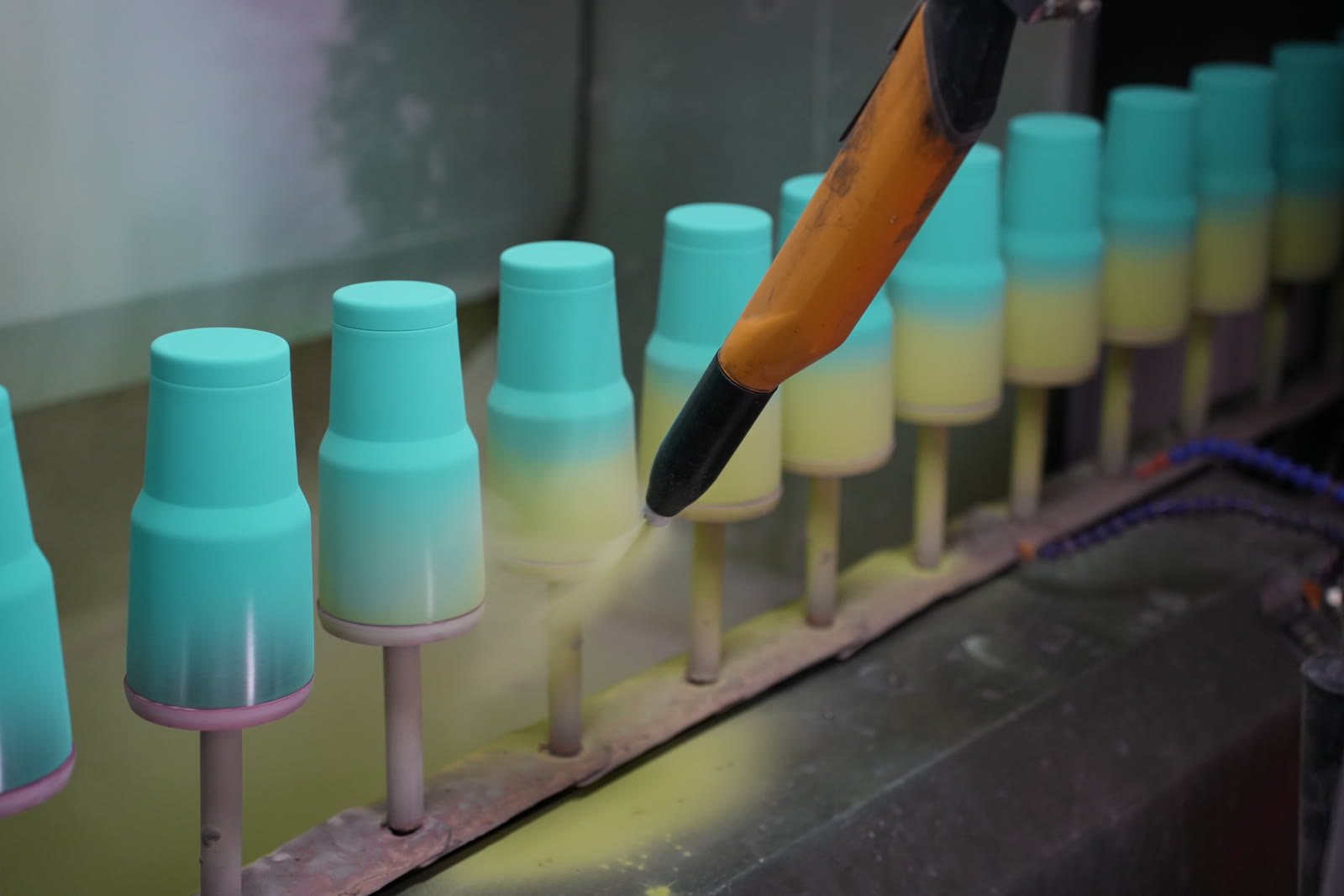
| Powder coat | Chalking, gloss loss, rim or base chips | Hundreds of cycles if well cured, far sooner if under-cured | Pretreatment, film thickness, oven time and temperature |
| Base cap / sealing point | Trapped water, rust stain at base, later slow vacuum loss | Months | Base cap fit and sealing, how the vacuum sealing point is protected |
| Laser engraving | Rarely fails. Watch for lifted coat at the engraved edge | Late, if at all | Laser power and speed (a burnt edge is a weak edge) |
Two lessons from this table:
- The coating is rarely the first thing to go. The decoration and the lid usually fail before the powder coat does. A "dishwasher safe" test run on a blank coated body tells you nothing about your printed, lidded retail SKU.
- The base is the slow failure. Water trapped under a loose base cap does not show in a 10-cycle check. It shows as a rust ring or a tumbler that stops keeping drinks cold months later, when it is already a review, not a QC finding.
How EN 12875 Testing Works (and What It Does Not Tell You)
EN 12875-1 (Mechanical dishwashing resistance of utensils, Part 1: Reference test method for domestic articles) is the method European labs use when a product is labelled dishwasher safe. It covers ceramic, glass, metal, plastics, and coated or decorated articles, which includes insulated drinkware.
How it runs in practice:
- Cycle count: commonly 125, 250 or 500 cycles. Labs generally treat 125 as the reference point for plastics and decorated items, and 250-500 for robust ceramic, glass and metal.
- Evaluation: under EN 12875-2, washed articles are compared with an untested reference piece for changes in colour, gloss and physical condition.
- Samples and timing: one European lab's published terms are 4 articles per product, 3-8 weeks and roughly EUR 350-3,500 per product depending on cycle count.
What it does not tell you:
- It does not set a pass number. The standard does not define how many cycles a product must survive. The cycle count is a choice you make and then stand behind.
- It is a domestic-dishwasher method. If you sell to cafés, hotels or corporate canteens, commercial machines run hotter and faster and use harsher chemistry. A domestic 125-cycle pass is not a commercial-dishwasher claim.
- It is visual. It will not tell you whether the vacuum still holds. Add your own post-wash vacuum check (below).
Planning a private-label order with a "dishwasher safe" claim? Send us your SKU, decoration method and target market. We'll tell you which parts of the claim are realistic and what to test before you print the box. Ask our production team →
Matching the Label Wording to the Evidence You Have
The cheapest fix for dishwasher complaints is often the wording on the box. Choose the claim your evidence supports:
| Label wording | Evidence you should hold | Good fit for |
|---|---|---|
| "Dishwasher safe" | EN 12875-1 report on the finished, decorated SKU (body + lid), 125+ cycles, no visible change. Post-wash vacuum check passed | Laser-engraved or plain powder-coated tumblers with PP or Tritan lids |
| "Top-rack dishwasher safe" | Same test, run with the article placed in the top rack only | UV-printed designs with clear coat, most lids |
| "Body dishwasher safe, hand wash lid" | Separate results for body and lid | Complex slide or straw lids, clear AS lids, magnetic lids |
| "Hand wash recommended" | None needed | Sublimation, vinyl, decals, glitter or specialty finishes, gift-tier pieces with leather sleeves |
"Hand wash recommended" is not a failure. For a sublimation or glitter tumbler it is the honest claim, and it costs you nothing. The expensive mistake is printing "dishwasher safe" on a SKU whose decoration was never tested, then paying for the returns.
A Practical Test Plan to Put in Your PO
External lab testing takes weeks, so split it into a fast in-house screen and a formal report. This is what we suggest buyers ask any supplier for, us included:
- Pre-screen during sampling (in-house, about a week): run 20 top-rack cycles with standard detergent on 2-3 finished samples of each decoration. Anything that lifts, fades or clouds here will not survive the formal test, so fix it before you approve the golden sample.
- Adhesion before and after: cross-hatch tape test to ISO 2409 or ASTM D3359 on a washed sample and an unwashed control. A coating that looks fine can still have lost adhesion.
- Formal report (third-party, 3-8 weeks): EN 12875-1 at the cycle count you will claim, on 4 finished articles per SKU and decoration, evaluated to EN 12875-2. Book it in parallel with sampling so it does not delay production.
- Vacuum retention after washing: fill the washed tumblers with ice water and compare the outer-wall temperature (or the 6-hour retained temperature) with an unwashed control. A warm outer wall means the seal is compromised.
- Base inspection: remove the base cap on one washed piece and look for trapped water or rust staining at the sealing point.
- Write it into the PO: "Dishwasher claim: EN 12875-1, [125/250/500] cycles, [top rack / any rack], finished decorated article, no visible change per EN 12875-2, report reference [number]". That way the claim is tied to one production specification. If the factory later changes powder supplier or ink, the report no longer covers it.
Item 6 is the one buyers skip most often. Dishwasher resistance depends on process variables (pretreatment chemistry, powder batch, oven temperature and line speed), and a report is only valid for the process that made the tested samples. Ask for batch-level adhesion checks in your pre-shipment QC plan. Otherwise the report describes your samples, not your production run.
Dishwasher Safe vs Food Safe: Two Different Reports
Buyers sometimes assume an FDA, LFGB or Prop 65 report covers dishwasher claims. It does not. Food-contact testing (migration from the inner steel wall and the lid plastic into food simulants) answers "is it safe to drink from?" EN 12875 answers "does it still look and work the same after repeated washing?" You need both if you make both claims. Our drinkware compliance testing guide covers the food-contact side.
For Amazon sellers the two claims matter differently. Food-contact documents are what category approval and compliance requests ask for. The dishwasher claim is what drives returns and one-star reviews. We cover the listing side in our Amazon FBA private-label tumbler guide.
Choosing Decoration and Lids with the Dishwasher in Mind
If dishwasher safety is part of your pitch, especially for kids' cups, office mugs and family products, design for it from the start instead of testing your way out of problems later:
- Logo method: laser engraving is the most wash-resistant option, which is why it dominates corporate gifts. See our laser engraving guide. For full-colour art, UV printing with a clear coat is the realistic choice. Our powder coating vs UV printing comparison covers the durability trade-offs.
- Lid material: PP and Tritan copolyester are the usual dishwasher-friendly choices. If you want a crystal-clear lid, ask whether it is AS/SAN and test it specifically.
- Lid design: slide and flip mechanisms with hidden cavities trap water and detergent. Removable gaskets and a lid that fully disassembles make both the dishwasher and hand washing work better. See our tumbler lid types guide.
- Care card: even with a tested claim, tell users to remove the gasket and dry the lid open. It reduces mould and odour complaints, which consumers often blame on "the dishwasher". Our tumbler cleaning guide is a good source for care-card wording.
For kids' products the stakes are higher, because parents run everything through the dishwasher. On our kids cups line we recommend top-rack washing for lids and straws and full disassembly of the straw valve. That is the wording to test against.
Get a Dishwasher-Ready Tumbler Quote
Tell us your capacity, decoration (laser, UV, powder colour), lid type and the care claim you want on the box. We'll recommend a construction that can support that claim and help you plan the test sequence so it runs alongside sampling, not after it.
Request a Quote — Response Within 12 Hours →
Related guides: Powder Coated Tumblers Catalog | Tumbler QC & Factory Testing Guide | Why Tumblers Stop Keeping Cold | FDA, LFGB & Prop 65 Testing Guide | Sample Approval Guide