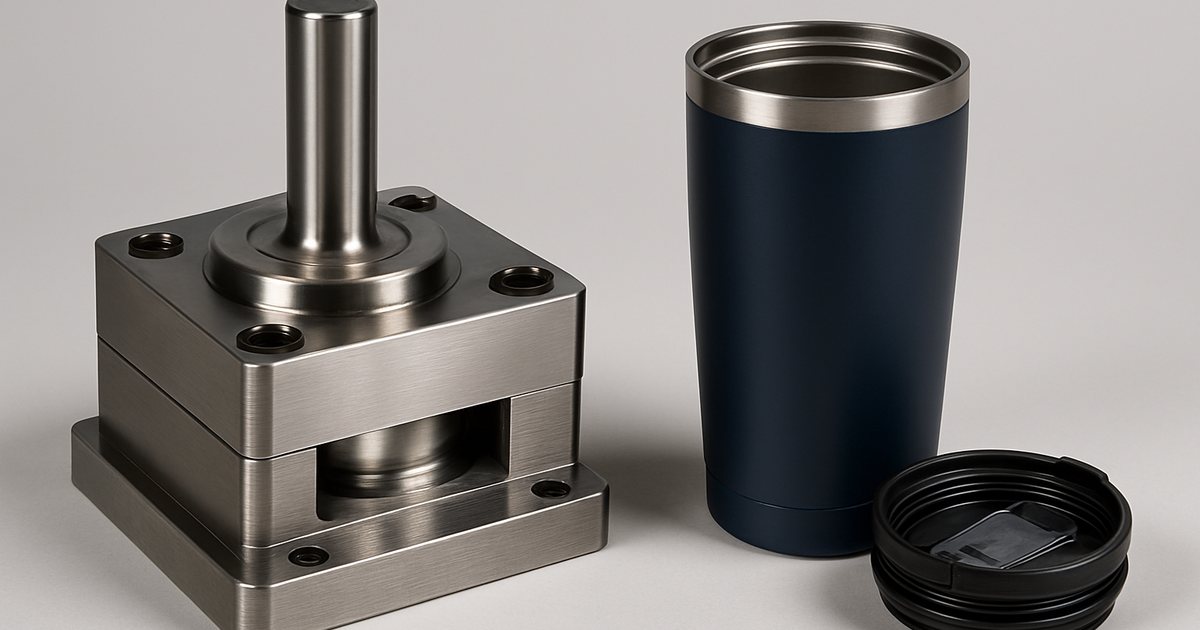
Quick answer: A proprietary tumbler body that runs on an existing lid platform costs $5,000-$9,500 in tooling at our Ningbo factory in 2026. A fully proprietary product - new body, new lid, new handle - runs $11,000-$19,000. The reason you will see quotes anywhere from $1,500 to $30,000 online is that an insulated tumbler is not one mold. It is a set of about nine tools, and most quotes only price some of them.
Every week we get some version of the same email: "How much for a custom mold?" It is the right question asked at the wrong resolution. Below is the whole tooling package broken out tool by tool, the amortisation math that decides whether the project makes commercial sense, the tool-life numbers, and the ownership terms you should insist on before you wire a deposit.
Why "One Mold" Is the Wrong Mental Model
A plastic bottle really is one mold. A double-wall vacuum stainless tumbler is a fabricated assembly, and each operation in the line has its own tooling. If you have not seen the sequence, our factory tour of the tumbler manufacturing process walks through it station by station.
Here is what a new shape actually requires:
| Tool | What it does | Typical 2026 cost | Needed when |
|---|---|---|---|
| Outer shell draw die set | Draws the visible body from flat 304 sheet in 2-4 progressive stages | $2,200 - $3,800 | Any new body silhouette |
| Inner liner draw die set | Draws the inner cup that holds the liquid | $1,600 - $2,800 | Any change to capacity or internal profile |
| Necking, curling & spinning tooling | Forms the mouth diameter, rolls the lip, closes the shoulder | $600 - $1,200 | Any change to mouth opening or shoulder |
| Base / bottom cap die | Stamps the base disc and the evacuation port seat | $400 - $800 | New base diameter or tapered base |
| Weld & vacuum fixtures | Holds the two shells concentric through welding and evacuation | $500 - $900 | Every new body, no exceptions |
| Lid injection mold | PP or Tritan lid body, slider or flip, straw seat | $2,800 - $6,500 | Only if you want a proprietary lid |
| Silicone gasket compression mold | Seal rings, base pad, straw gasket | $350 - $700 | New lid, or a new seal diameter |
| Handle / small part mold | Handle, straw, carry loop | $1,500 - $3,200 | Proprietary handle geometry |
| Decoration & coating jigs | Laser rotary fixture, print cradle, powder-coat hanging rack | $150 - $400 | Every new body profile |
Add the mandatory items only - shell, liner, necking, base, fixtures, jigs - and a body-only project lands at $5,450-$9,900. Add a proprietary lid, gasket and handle and you are at $11,000-$19,000. That is the honest range, and it is why a single "$1,500 mold cost" number circulating on sourcing forums is not comparable to anything. It is usually one die, or a modification of a body that already exists on a factory's shelf.
Not sure yet whether your design needs new tooling at all? Send us a sketch or a reference product and we will tell you within one business day which tools are genuinely required and which can run on existing sets. Start a custom development enquiry →
The Four Tiers of Customisation - and What Each Actually Costs
Most brands who ask us for tooling do not need tooling. They need their product to look different on a shelf, which is a different problem with a much cheaper solution. Here is how we tier it internally:
| Tier | What changes | Tooling cost | MOQ | Lead time to first shipment |
|---|---|---|---|---|
| 0 - Decoration only | Your logo on a stock body: laser, screen print, UV | $0 (setup $45-$150) | 500 pcs | 30-35 days |
| 1 - Cosmetic | Custom Pantone powder coat, custom lid colour, custom silicone sleeve colour, retail packaging | $0 - $700 | 1,000 pcs per colour | 35-45 days |
| 2 - Proprietary body | New silhouette on an existing lid platform and existing mouth diameter | $5,000 - $9,500 | 3,000 pcs | 90-110 days |
| 3 - Fully proprietary | New body, new lid, new gasket, new handle | $11,000 - $19,000 | 5,000 - 10,000 pcs | 120-150 days |
The jump that matters is between Tier 1 and Tier 2, and it is not really about money. It is about time and risk. Tier 1 is 45 days and reversible. Tier 2 commits you to a shape for years and puts four to five months between your decision and your first sellable unit. We have watched more brands lose a season to that gap than lose money on the tooling itself.
A practical middle path we recommend often: launch on a stock body with a genuinely distinctive colour, lid and box - our colours and finishes guide and packaging options guide cover what is possible without tooling - then fund proprietary tooling out of the first year's sell-through, when you know which size actually moves.
The Amortisation Math That Decides the Project
Tooling is not a cost. It is a cost per unit, and the number of units you divide it by is the only variable that matters. Here is $8,000 of Tier 2 tooling spread across realistic first-year volumes:
| Annual volume | Tooling per unit | Effect on a $4.20 FOB body | Verdict |
|---|---|---|---|
| 3,000 pcs | $2.67 | $6.87 - up 64% | Do not do it |
| 5,000 pcs | $1.60 | $5.80 - up 38% | Only for a funded brand launch |
| 10,000 pcs | $0.80 | $5.00 - up 19% | Defensible |
| 25,000 pcs | $0.32 | $4.52 - up 8% | Comfortable |
| 50,000 pcs | $0.16 | $4.36 - up 4% | Rounding error |
| 100,000 pcs | $0.08 | $4.28 - up 2% | Should have done it sooner |
The break-even most brands should use: if you cannot see a path to 20,000 units within 24 months, custom tooling is a branding expense, not an investment. Below that line you are paying roughly $0.40+ per unit for a shape, which is more than the entire powder-coating operation costs. Above 25,000 units the tooling disappears into rounding and the exclusivity is close to free.
Two adjustments to run on your own numbers. First, tooling is spent once but sells for years - a tool still running in year three has amortised to nothing. Second, if you are landing goods into the US, remember that duty and freight are charged on the unit price, so the tooling amortisation does not compound; our landed cost and HS code guide shows where each cost actually attaches.
Who Owns the Mold: Three Arrangements and the Clauses That Matter
This is the single most expensive thing buyers get wrong, and it costs nothing to get right. There are three arrangements in this industry:
| Arrangement | Who pays | Who owns | What you actually get |
|---|---|---|---|
| Buyer-owned tooling | Buyer pays 100% up front as a separate line | Buyer | Title to the physical tool, right to inspect it, right to move it to another factory |
| Amortised tooling | Cost buried in the unit price over an agreed volume | Factory | Exclusivity for a defined period - not ownership |
| Factory-funded tooling | Factory pays | Factory | A lower entry cost and no claim on the shape at all |
All three are legitimate. What is not legitimate is being told you own a tool you have only amortised. Put these five clauses in the tooling agreement before the deposit leaves your bank:
- Ownership and marking. "Tooling is the property of the Buyer and shall be permanently marked with the Buyer's tool identification number." An unmarked tool in a factory holding 400 tools is not a tool you can identify, let alone reclaim.
- Exclusivity, with teeth. Define the exclusivity period in months and the minimum annual volume that keeps it alive. Open-ended exclusivity with no volume condition is what factories quietly ignore.
- Storage and maintenance. Who cleans, oils and stores the tool between runs, and for how long dormant tooling is retained before the factory may scrap it. One to two years is the industry default; say so explicitly.
- Transfer conditions. What must be settled before the tool physically leaves - typically all open invoices - and who bears crating and freight. A die set for a 40oz body is heavy; this is not a trivial line.
- Drawings and 3D data. Ownership of the CAD, the DFM-revised files and the final tool drawings. If you own steel but not the data, re-cutting elsewhere means paying the engineering again.
We put all five into our own tooling agreements as standard, because arguing about them in year two is worse for us than agreeing them in week one. If a supplier resists writing any of them down, that answer is itself the information you needed. Our guide to choosing the right tumbler factory in China covers the rest of the vetting checklist.
Tool Life, Tool Steel, and What Actually Kills a Mold
Buyers ask how many units a tool is good for. The honest answer is that for almost every brand, tool life is not the binding constraint:
| Tool type | Material | Rated life | What wears first |
|---|---|---|---|
| Deep-draw die set (body) | Cr12MoV / SKD11 tool steel | 300,000 - 800,000 hits | Draw radius on the die shoulder; inserts are replaceable |
| Necking & curling tooling | Hardened tool steel | 500,000+ cycles | Curl roller surface |
| Lid injection mold (economy) | P20 pre-hardened | 300,000 - 500,000 shots | Parting line flash, slider wear |
| Lid injection mold (production) | 718H / H13 hardened | 1,000,000+ shots | Gate erosion |
| Silicone compression mold | Aluminium or P20 | 200,000 - 400,000 cycles | Flash land flatness |
At 25,000 units a year, a P20 lid tool has a 12-year theoretical life. What ends tools early is neglect, not cycles. A draw die left uncleaned through a humid Ningbo summer develops surface pitting, and pitting on a draw radius transfers directly onto the visible outer shell of every unit that follows. When we quote buyer-owned tooling we include scheduled cleaning and oiling between runs; if you are comparing quotes, check whether the cheaper one does. Our quality control and factory testing guide explains what we inspect on first articles off a new tool.
The Development Timeline, Stage by Stage
Here is the schedule we run for a Tier 2 project, from signed drawing to goods on the water:
| Stage | Duration | What you owe us | What can go wrong |
|---|---|---|---|
| Engineering & DFM review | 5-7 days | 3D file or dimensioned sketch, capacity target | Draw ratios that cannot be formed in 3 stages |
| 3D-printed appearance model | 3-5 days | Approval of proportions in the hand | Renders always look taller than the real thing |
| Tool fabrication | 25-35 days | 50% tooling deposit | Nothing, if the DFM was done properly |
| T1 trial shots | 5 days | Fast feedback on 3-5 sample units | Wall thinning at the shoulder; lid fit |
| T2 modification | 7-10 days | Written sign-off on changes | Appearance changes here are billable |
| Pre-production sample | 7 days | Written approval - the legal reference for the order | Skipping it, which is how disputes start |
| Mass production (5,000 pcs) | 25-30 days | Balance per contract | Colour matching across coating batches |
| Ocean transit Ningbo - USWC | 28-35 days | - | Port dwell; Chinese New Year |
Total: 105-135 days to a US warehouse, and that assumes one clean modification round. Add three weeks to anything crossing Chinese New Year, which falls in mid-February 2027. If you need product for a specific season, count backwards from the shelf date and be ruthless about it - the most common tooling failure we see is not a technical one, it is a brand that tools a beautiful product and lands it eight weeks after its selling window closed.
Five Ways to Get a Distinctive Product Without Buying a Die Set
Since our commercial interest points the other way, take this as read: most brands should exhaust these first.
- Custom Pantone powder coat. $0.20-$0.45 per piece over a stock colour at 1,000 pieces per colour. The single highest-impact change per dollar, and it needs no tooling at all. See our powder coated tumbler range for the base bodies.
- Swap the lid platform. A flip-top instead of a slider, or a clear straw lid instead of solid, completely changes the silhouette in a product photo and costs nothing if the mould already exists. Our lid types guide covers what fits which mouth diameter.
- Custom silicone. A branded base pad or a coloured sleeve is a $350-$700 compression mold - an order of magnitude below a body die set - and it is the part the customer's hand touches.
- Retail-ready packaging. $0.35-$0.90 per unit turns a commodity into a gift. It also photographs better than any body curve.
- Combine a stock body with an exclusive colour-and-lid combination. Contractually lock the combination rather than the geometry. It is enforceable, it costs a fraction, and no competitor can copy it without going through the same factory.
If, after all five, your product still needs a shape nobody else has - because you are defending a design patent, matching a proprietary cup holder, or building a line that has to look like a family - then tooling is the right answer, and the numbers above are what it costs.
What to Send Us to Get a Real Tooling Quote
We can quote tooling accurately in one to two business days if we have five things: the target capacity in ounces, a 3D file or dimensioned sketch (a photo of a competitor product with your intended changes marked is fine), whether you need a proprietary lid or can run on an existing platform, your first-order and 12-month volume estimates, and your target shelf date. Missing the last two is why quotes come back as ranges.
What you will get back is a tool-by-tool cost breakdown like the table at the top of this article - not a single lump number - along with the MOQ, the honest timeline, and our recommendation on whether the project should be Tier 2 at all. If we think you should be spending the money on colour and packaging instead, we will say so. Before your first order, our step-by-step MOQ and first-order guide and our factory-direct pricing guide for distributors are worth reading alongside this one.
Hongming has been manufacturing double-wall vacuum stainless drinkware in Ningbo since 2013, with in-house deep-draw, welding, vacuum, powder-coating and decoration lines, and we run buyer-owned tooling for brands in the US, EU and Australia. We hold current FDA 21 CFR and LFGB food-contact reports on our core lines and work to ASTM A240 material specifications for 304 and 316 stainless.
Request a Quote for Custom Tumbler Tooling → Send your drawing or reference product and we will come back with a tool-by-tool breakdown, MOQ and lead time within one business day.
Related guides: How Tumblers Are Made: Factory Tour | How to Find the Right Factory in China | MOQ & First Order Guide | Factory QC & Testing | Landed Cost, HS Codes & Duty