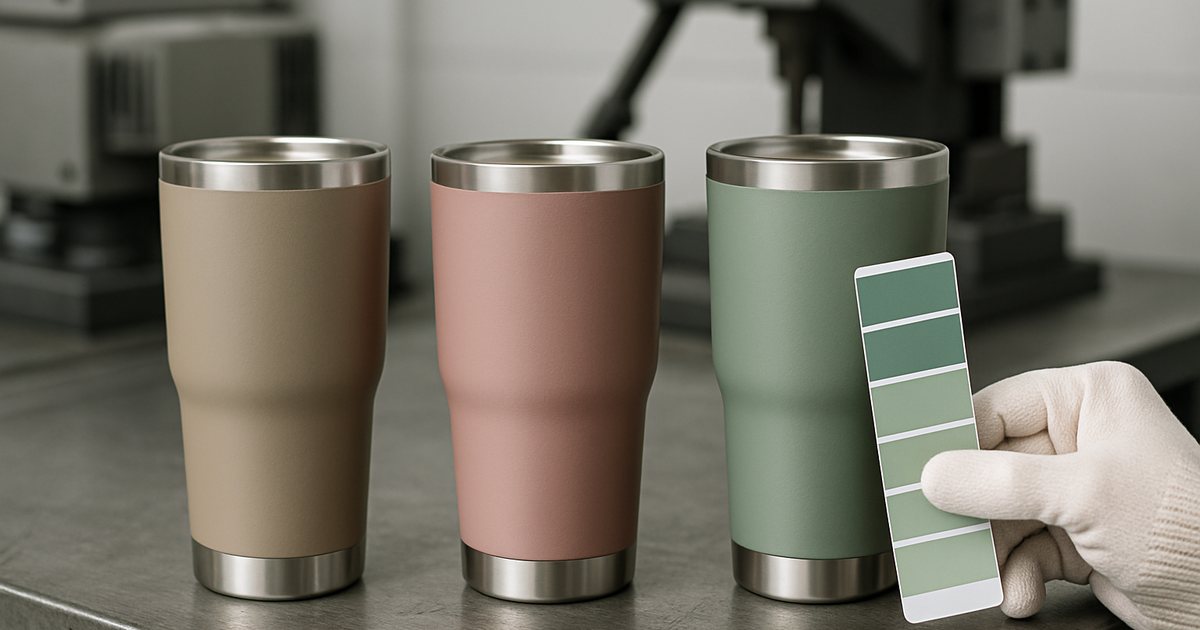
Quick answer: Before any bulk tumbler order, you should see at least two sample stages — a confirmation sample (your actual color, logo, and lid, produced 3-10 days depending on customization) and a signed-off golden sample that becomes the legal reference for the whole order. A counter sample is a third type, used only when you are matching an existing product rather than a spec sheet. Expect to pay $15-60 per unit depending on complexity, refundable against orders of 300-500+ pieces, and budget 5-10 working days per round. What almost nobody tells buyers: some of the most important tests — salt spray corrosion resistance and real-world vacuum failure rate — cannot finish before you have to sign off the golden sample. That gap is the actual subject of this guide.
Why the Sample Stage Decides Everything That Follows
We have run tumbler production lines in Yongkang for years, and the orders that go wrong almost never go wrong in production. They go wrong three weeks earlier, at the sample stage, when a buyer approves a sample that does not represent what the line will actually produce — or skips a sample stage entirely to save a week.
A sample locks three things: color (matched under the actual powder-coat cure schedule, not a digital mockup), fit (lid seal, straw length, handle clearance against your specific mold), and decoration registration (where your logo actually lands on a curved surface, not where it looks centered in a flat file). Once you sign off, that sample — not your PO, not your tech pack — becomes what the factory is legally producing to. If it is wrong, the mistake ships 5,000 times.
Three Samples, Three Different Jobs
Buyers who have only sourced once or twice tend to use "sample" as one word for three different things. Each type answers a different question, and mixing them up is where disputes start.
| Sample type | Answers the question | Who provides the reference | Typical cost | Lead time |
|---|---|---|---|---|
| Counter sample | "Can you replicate this exact tumbler I already own or bought elsewhere?" | You send a physical unit or photos with measurements | $20-40/unit | 5-7 days |
| Confirmation / pre-production sample | "Does this match my spec sheet — color, logo, lid, capacity?" | You send a tech pack, Pantone code, and logo file | $15-60/unit (see table below) | 3-10 days |
| Golden sample | "Is this the exact, final, signed-off reference the whole order will be checked against?" | Confirmation sample, once approved and physically retained by both sides | No extra cost — it is the approved confirmation sample | Immediate on approval |
The distinction that causes the most disputes is between "confirmation sample" and "golden sample." A confirmation sample is a draft. A golden sample is the one both sides keep a physical unit of — one in your office, one in our QC room, both marked with the order number — and the one our line workers physically compare finished units against during production, not a photo in a chat thread. If your supplier only emails you photos and never asks you to keep a physical retained unit, you do not have a real golden sample; you have an unenforceable approval.
How Many Rounds You Actually Need, by Customization Level
The honest answer is "it depends on how much you are changing," so here is what that looks like in practice on a standard 30-40oz double-wall tumbler:
| Customization level | Typical rounds | Cost per sample | Total lead time |
|---|---|---|---|
| Stock color, existing mold, logo only | 1 round (rarely a 2nd) | $15-25/unit | 3-5 days |
| Custom Pantone-matched color, existing mold | 1-2 rounds (color panel, then full unit) | $35-60/unit | 5-7 days |
| New custom mold (body, lid, or handle) | T1 sample + typically 2 revision rounds | $15-30/unit from production tooling | 7-10 days per round, after 20-35 days of tooling |
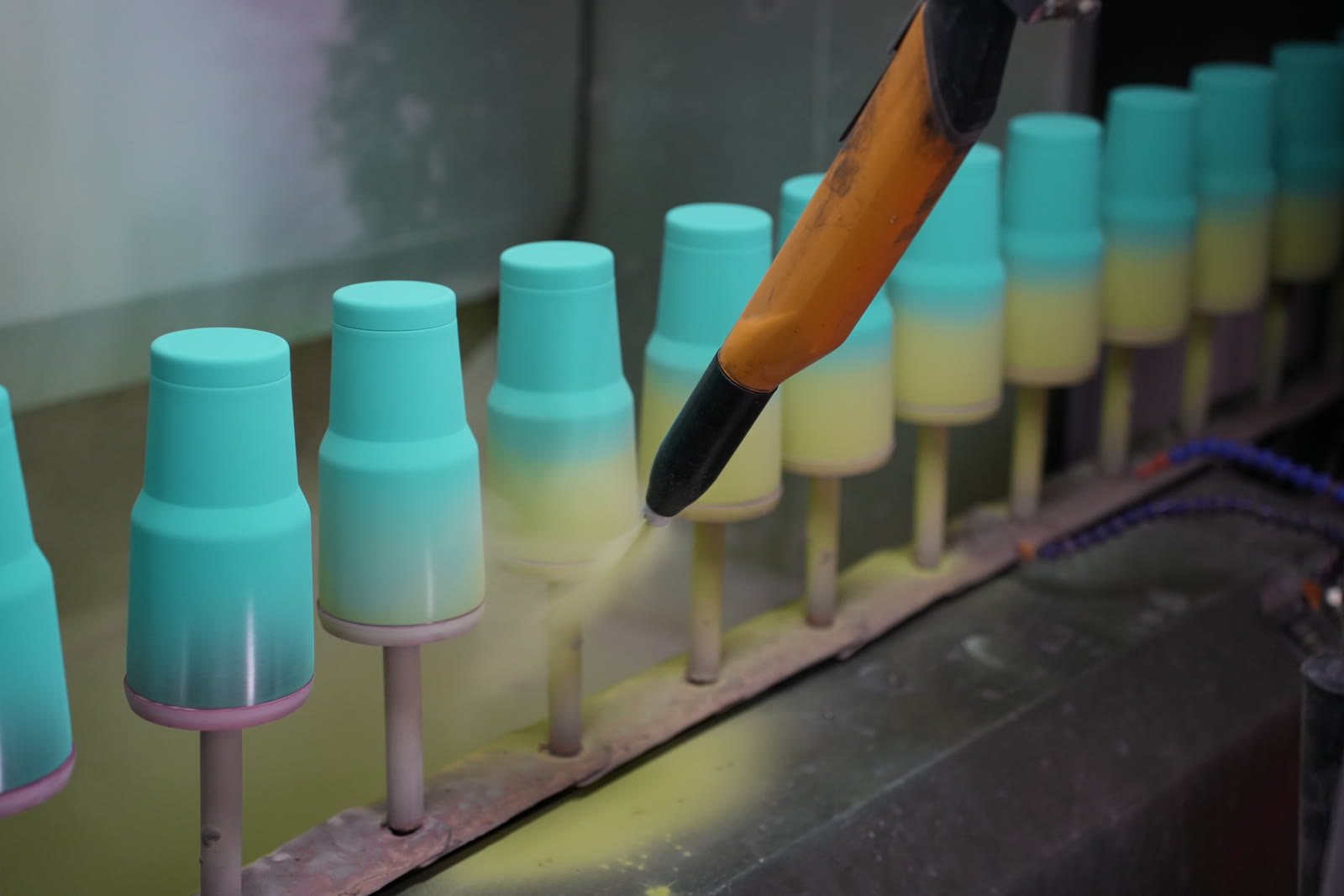
Two things buyers consistently underestimate here. First, a custom Pantone color needs its own round even on an existing mold, because we are not painting the sample — we are mixing a new powder formula and running it through the actual 200°C, 20-minute cure cycle to check how it reads on your specific tumbler curvature and finish (matte, semi-gloss, or textured all shift the same Pantone value slightly). Approving a color from a flat printed swatch and skipping the cured test panel is the single most common reason buyers reject their first production batch.
Second, a new mold order is not "sample once, then production." T1 (first tool-off) samples almost always need at least one dimensional correction — a lid that seats 0.2mm too tight, a handle that clears the mold line but not your case pack. Budgeting for exactly one revision round, not zero, is the difference between a realistic launch date and a missed one.
Need help scoping which level applies to your design? Send us your logo and target color — we will tell you which round count and cost bracket your order actually falls into.
The Sample Approval Checklist We Use in Our Own QC Room
This is the same six-point check our own line supervisors use before a golden sample is retained. Run it yourself before you sign off, even on a sample from us:
- Color, under two light sources. Check the sample under daylight and under warm indoor LED — a color that matches under one often shifts visibly under the other (a phenomenon called metamerism). We target Delta E ≤2.0 against your Pantone reference under D65 standard light.
- Capacity to the fill line, not the rim. Fill with water to the printed or engraved fill line, then measure. A tumbler that holds its stated 40oz to the rim but only 36oz to a realistic fill line will generate return complaints later.
- Lid seal, inverted for 30 minutes. Fill, seal, and invert the sample over a dry towel. Any moisture on the towel after 30 minutes is a lid gasket or thread problem — not a factory defect you can fix after shipment.
- Logo registration and engraving depth. Laser engraving should read consistently under raking light with no double-strike ghosting. UV print edges should not show pixelation at 15cm viewing distance.
- Weight, against a written spec. A stainless tumbler that is 8-10% lighter than your approved sample usually means thinner-gauge steel substituted in production. Weigh your golden sample and write the number into your PO.
- A same-day thermal check. Fill with ice water, wrap the outside dry, and check for condensation at 1 hour and 4 hours. This will not predict long-term vacuum life (see below), but it catches a sample that never sealed properly in the first place.
What the Golden Sample Cannot Tell You Yet
Here is the part most sourcing guides skip, because it is uncomfortable: the golden sample sign-off happens before two of the most important test results exist.
Salt spray corrosion testing to ASTM B117 — the standard test for whether a powder coating will resist chipping and corrosion in real use — runs for 500+ hours, or about 21 days. Cross-hatch adhesion testing (ASTM D3359) finishes faster, but full weathering data does not. Most sample-and-approval cycles complete in 5-10 days. That means on a normal timeline, you are approving color and fit before the coating's long-term durability data is back, not after.
The second gap is bigger. Our own data on double-wall vacuum tumblers shows that a standard AQL 2.5 pre-shipment inspection accepts a lot with a real 3% vacuum failure rate about 96% of the time — because a 200-piece sample from a 5,000-piece lot simply cannot see a defect that clusters in specific furnace loads. A single golden sample, hand-picked and hand-tested, tells you even less. One perfect sample proves the design and the mold are right. It does not prove the production line's sealing and welding process holds up at 5,000 units, and it never will — that can only be shown by 100% in-line testing during the real run, not by any sample. We wrote a full breakdown of this statistics problem, with the AQL acceptance-probability table, in our tumbler vacuum failure guide.
What this means practically: treat the golden sample as proof that the design is right, not proof that the batch will be right. Ask your supplier for 100% in-line vacuum testing records and salt-spray results from the same color/coating formula on a previous order, since a fresh 21-day test cannot exist yet for a brand-new custom color.
Sample Cost and Refund Terms: What's Reasonable to Ask For
Sample cost should scale with what is actually being made, not be a flat number. As a buyer, the two questions worth asking every quote are:
- Is the sample fee refundable, and at what order size? On our line, sample cost is credited against bulk orders of 300-500+ pieces, depending on the model. Below that threshold, the sample fee is not refunded because the color mixing and setup cost is real regardless of the follow-on order size.
- Does the quote separate design/engineering cost from sample production cost? A new mold quote should show tooling ($2,000-15,000 depending on complexity), a T1 sample fee, and revision sample fees as separate line items. A single bundled number makes it impossible to tell whether you are being charged twice for one mold correction.
A reasonable total sample budget for a first order using an existing mold in a custom Pantone color is $150-400 covering 2-5 units plus two-way express shipping. That is almost always under 1% of the value of a 500-1,000 piece production order — money that is cheap next to the cost of correcting a color or fit mistake across a full container.
Red Flags During the Sample Stage
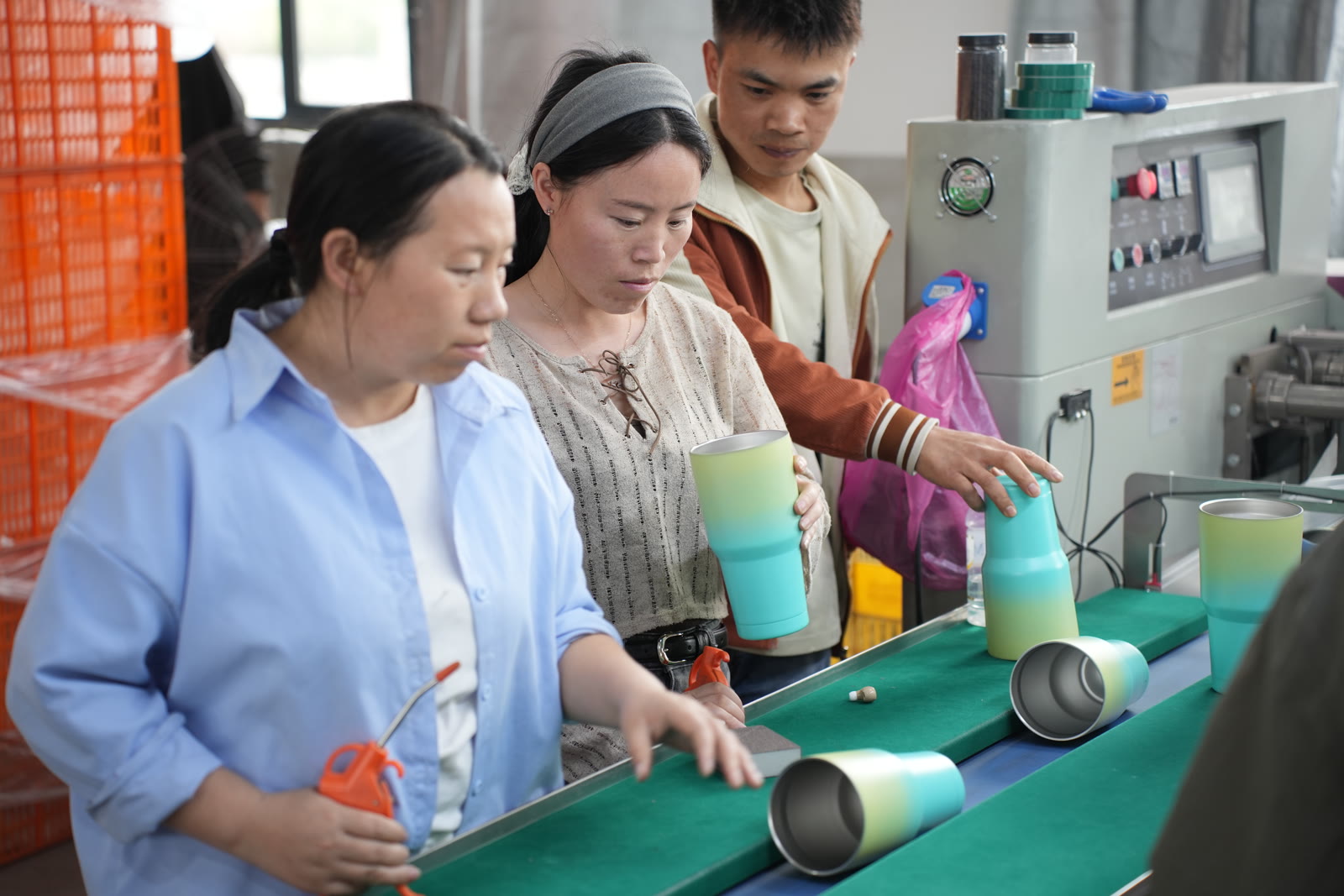
Five things we tell every new customer to watch for, based on the disputes we have seen resolved (and unresolved) between other buyers and other factories:
- A stock sample with a printed logo mockup taped or pasted on. This tells you nothing about how your actual decoration method will look on the real curvature and finish. Insist on your logo actually applied to the sample.
- No physical retained unit on either side. If "approval" is a photo in a WeChat or WhatsApp thread with no unit kept in your office, you have no reference to hold a disputed shipment against later.
- A sample cost so low it does not cover real material and labor. A custom Pantone color sample under $15 usually means the "custom color" is actually the closest stock color with no new powder batch mixed — check the color under two lights (checklist item 1) if the quote seems unusually cheap.
- Verbal-only revision commitments. "We will fix that in production" without a written note on the PO or a documented second sample round is the most common source of "but you approved it" disputes.
- A rushed sample timeline that skips the cure or weld cycle. Powder coating cured for less than the full 20 minutes at 200°C can look identical on day one and chip within weeks. If your sample turnaround is faster than your own supplier's stated production cycle time, ask why.
Every expensive drinkware order failure we have seen started with skipping one of these five steps to save a few days.
Fitting Sample Rounds Into Your Overall Production Calendar
Sample approval is not a side task — it sits directly on your critical path. For an existing-mold order: allow 3-10 days for sampling before your 25-30 day production clock even starts. For a new mold: 20-35 days of tooling, then a T1 sample and typically two revision rounds at 7-10 days each, before production begins. If you are ordering ahead of Chinese New Year or China's National Day (Golden Week, 1-7 October), each of those holiday windows removes a working week from your sample-and-revision schedule — our production calendar guide has the full week-by-week breakdown for planning around both.
The practical rule: whatever your target ship date is, count backward from it using the table above before you count forward from today. Most missed launch dates we see are not production delays — they are sample-stage delays that nobody built into the calendar.
Get a Sample Quote for Your Design
Send us your logo file, target Pantone color, and quantity, and we will tell you exactly which sample round and cost bracket your order falls into — plus a realistic sample-to-shipment timeline.
Request Your Sample Quote — Response Within 12 Hours →
Related guides: Custom Mold & Tooling Cost Breakdown | Why Tumblers Lose Vacuum (and Why AQL Can't Catch It) | Our Factory QC Testing Process | First Order From China, Step by Step | How to Find the Right Factory