
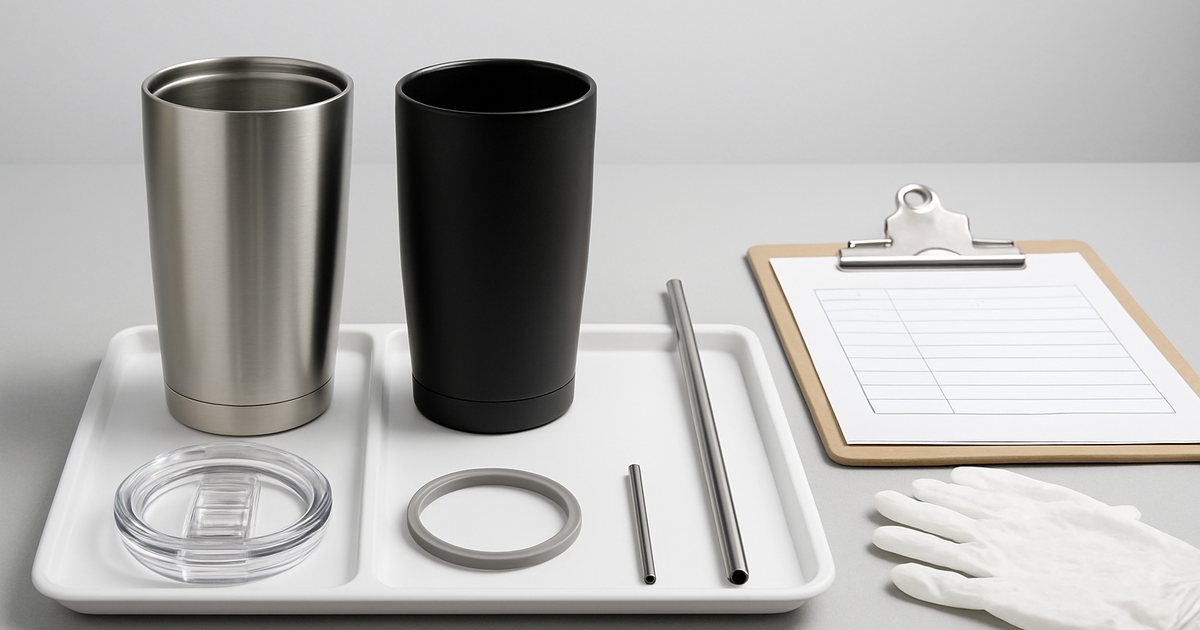
Quick answer: There is no such thing as an FDA-certified tumbler. What exists is a third-party lab report showing your specific components comply with specific regulation sections. For a US and EU launch, budget $900-$1,600 per SKU and 10-15 working days for a combined FDA + LFGB + Prop 65 package, plus $250-$500 if you need a PFAS screen. Kids cups add another $600-$1,500 because CPSIA is a separate regime. The parts that fail are almost never the stainless body — they are the lid, the gasket, the straw, the coating pigment and the vacuum sealing dot on the base.
We are an insulated drinkware factory in Yongkang, Zhejiang, and we hold the test files for the products we ship. This guide is written from the QA desk rather than from a regulatory summary: what we actually send to the lab, what it costs us, what comes back failed, and how to check that the report a supplier hands you is real.
The Five Documents a Buyer Actually Needs
Most sourcing checklists list a dozen acronyms. In practice, which documents you need is determined entirely by where the goods land and who the end user is. Here is the honest matrix:
| Destination / product | What you need | Key reference | Typical cost per SKU |
|---|---|---|---|
| United States, adult drinkware | Food-contact report to 21 CFR + Prop 65 heavy metals | 21 CFR 175.300, 177.1520, 177.2600; CA Prop 65 | $370-$700 |
| United States, childrens cup | All of the above + CPSIA CPC, third-party lead testing, tracking label | 16 CFR 1303; 15 U.S.C. 2063; ASTM F963 if toy-like | $780-$1,850 |
| EU / UK, adult drinkware | Framework + plastics declaration of compliance, metal release | (EC) 1935/2004; (EU) 10/2011; CoE CM/Res(2013)9 | $400-$750 |
| Germany specifically | LFGB including sensory testing | LFGB §30/§31; DIN 10955 | $450-$900 |
| Minnesota / Maine retail | PFAS total organic fluorine screen or supplier attestation | Combustion ion chromatography, 50 ppm screening trigger | $250-$500 |
| Amazon US listing | Food-contact report dated within 12 months, matching the exact ASIN | Seller Central compliance request | Reuse of the above |
Notice what is not on this list: CE marking. CE does not apply to drinking cups. There is no CE directive for a vacuum tumbler, and a supplier offering you a "CE certificate" for one is either confused or hoping you are. CE appears legitimately on electric kettles and on toys, not on a stainless steel cup.
FDA: A Report, Never a Certificate
The single most common misunderstanding in this category is that the FDA issues something. It does not. The agency writes the rules in Title 21 of the Code of Federal Regulations and enforces them at the border and in the market; it does not audit factories in Zhejiang and hand out certificates.
So when we prepare a US food-contact file for a tumbler, we send the lab a disassembled cup and the report comes back component by component:
| Component | Material | Regulation section tested against |
|---|---|---|
| Body, inner wall | 304 or 316 stainless steel | General food-contact safety; metal release by CoE reference method |
| Interior / exterior coating | Polyester powder coat | 21 CFR 175.300 (resinous and polymeric coatings) |
| Lid body and straw | PP / Tritan | 21 CFR 177.1520 (olefin polymers) |
| Sealing gasket | Food-grade silicone | 21 CFR 177.2600 (rubber articles) |
| Handle grip | PP or TPE | 21 CFR 177.1520 / 177.2600 as applicable |
Two practical consequences follow from this. First, a report is only evidence for the parts that were on the bench. If you change your lid supplier after approval — which happens constantly when buyers chase a two-cent saving — the report no longer describes your product. Second, migration testing simulates real use: 10% ethanol and 3% acetic acid food simulants, held at temperature for a defined period. A cup that will hold coffee at 90°C is not tested the same way as a cold-only cup. Tell your factory the intended use before they book the test, or you will get a report that a retailer refuses.
If you are still deciding between steel grades before you commit to testing, our breakdown of 304 vs 316 stainless steel with factory test data covers the corrosion and metal-release differences that show up in these reports.
LFGB: Where FDA-Passing Cups Go to Die
German LFGB is the strictest routine food-contact regime you will meet in this industry, and it fails products that sail through US testing. There are two reasons.
Sensory testing. Under §30 and §31 of the LFGB, an article must not transfer taste or odour to food. The method is DIN 10955: a trained panel fills the article, conditions it, and scores transfer from 0 (no perceptible difference) to 4 (strong). Grade 2.5 is usually the pass ceiling. No chemical limit is exceeded when a product fails here — it simply smells. In our experience, three things cause it:
- Under-cured powder coating. Our cure schedule is 200°C for 10 minutes at part temperature. Run it short to push throughput and residual solvents stay in the film. The cup passes migration and fails sensory.
- Cheap silicone gaskets. Non-post-cured silicone off-gasses. Post-curing at 200°C for 4 hours adds about $0.04 per gasket and eliminates the problem.
- Adhesive residue from bottom pads or straw sleeves left in a closed cup during shipping.
Metal release. LFGB metal work references the Council of Europe Resolution CM/Res(2013)9 specific release limits — 0.14 mg/kg for nickel, 0.250 mg/kg for chromium, 1.8 mg/kg for manganese, among others. This is the test that quietly disqualifies 201-grade stainless. 201 substitutes manganese for nickel to cut cost, and manganese is exactly what the resolution limits. If a supplier quotes you a suspiciously cheap "stainless" cup for the German market, the material is the reason and the lab will find it.
Need the paperwork before you commit? We can send existing FDA, LFGB and Prop 65 reports for our stock models before you place a sample order. Ask our team which SKUs already have current files.
California Prop 65: The Sealing Dot Nobody Tests
Proposition 65 is not a product standard. It is a warning law: sell a product in California that exposes a user above the listed threshold and you must warn, or face a private enforcement action. The thresholds are low enough that trace contamination is a real risk — the lead No Significant Risk Level for reproductive toxicity is 0.5 micrograms per day, cadmium sits at 4.1 µg/day, and DEHP at 410 µg/day.
Here is what our internal failure log says about where lead actually comes from in a vacuum tumbler:
| Source | Why it happens | Fix |
|---|---|---|
| Vacuum sealing dot on the base | The port used to evacuate the cavity is sealed with a filler alloy; older alloys were lead-bearing | Lead-free sealing alloy; the dot is covered by the base pad but must still be tested |
| Bright brass / copper exterior finishes | Decorative plating chemistry | Test every metallic finish separately, not just one colour of the family |
| Deep red and yellow pigments | Historic pigment chemistries; modern powder is generally clean but sourcing varies | Certificate of analysis from the powder supplier plus per-colour testing |
| Painted straw tips and decorative appliqués | Secondary decoration applied outside the main coating line | Include in the tested assembly |
The base dot is the one buyers never think to ask about, because it is hidden under the rubber foot. Ask your factory directly whether their vacuum sealing alloy is lead-free and ask for the test that proves it on the base area specifically, not on the cup interior.
Kids Cups Are a Completely Different Regime
The moment a product is designed for children 12 and under and it is going to the United States, CPSIA applies and it is not optional. You need:
- Third-party testing at a CPSC-accepted laboratory — not just any accredited lab
- Total lead in substrate at or below 100 ppm
- Lead in surface coating at or below 90 ppm under 16 CFR 1303
- A Children Product Certificate issued by the importer, not by the factory
- Permanent tracking labels on the product and packaging identifying manufacturer, location and date of production
- Phthalate testing if there are flexible plastic parts
- ASTM F963 mechanical and physical testing if the cup has play value — small parts, sharp edges, cord and strap length
The CPC point is the one that catches new importers: the certificate is issued by you, based on the lab report. No Chinese factory can issue a valid CPC on your behalf. If a supplier offers you one, that is a signal about how they handle the rest of your compliance.
Europe is the mirror image and simpler than most buyers expect. A plain kids drinking cup in the EU is a food-contact article under Regulation (EC) No 1935/2004, not a toy — so EN 71-3 does not automatically apply. It becomes relevant only when the article has genuine play value, such as a moulded character lid. We have watched buyers pay for a full EN 71 package on a plain straw cup that never needed it.
Material choice matters more here than anywhere else in the catalogue. Our note on why 316 stainless is the right grade for kids bottles explains the corrosion and metal-release reasoning behind the specification we run on the kids cup line.
PFAS: The 2026 Question Every Retailer Now Asks
Two years ago nobody asked us about PFAS in drinkware. In 2026 it is on most US buyer questionnaires, driven by state-level restrictions on intentionally added PFAS in consumer product categories — Minnesota and Maine are the ones our customers cite most often, and the category lists and effective dates differ between them, so confirm the current statutory text for your specific product with your own counsel rather than relying on a supplier summary.
The factory-side answer is straightforward:
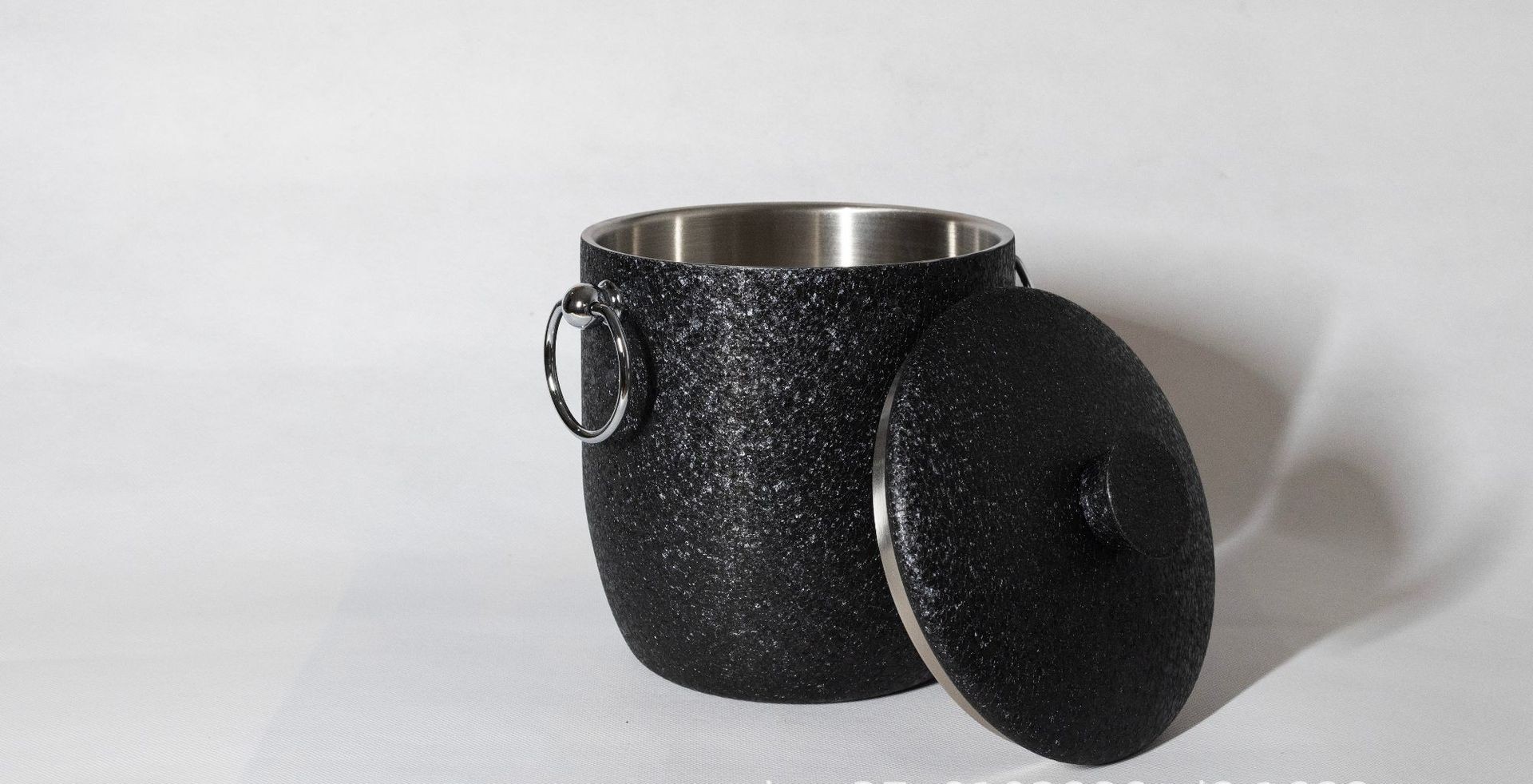
- Standard polyester TGIC powder coating contains no intentionally added PFAS. This is what goes on our powder coated tumblers and ice buckets.
- The genuine PFAS risk in drinkware is fluoropolymer non-stick interior lining — a PTFE-type coating on the inside of a cup. There is no reason for one to be there on an insulated tumbler.
- Screening method is combustion ion chromatography for total organic fluorine, with 50 ppm widely used as the trigger threshold below which a product is treated as free of intentionally added PFAS.
Cost is $250-$500 per SKU and about 10 working days. Get it done once per coating supplier rather than per colour, and get it done before a retailer asks — a compliance request with a 72-hour deadline is not when you want to be booking lab time.
What Testing Actually Costs and How Long It Takes
These are the prices we pay at ISO/IEC 17025 accredited labs in China in 2026. Your own numbers will vary by lab, by how many SKUs you batch together, and by whether you need rush service, but this is the right order of magnitude to budget against:
| Test package | Cost per SKU | Working days | Samples consumed |
|---|---|---|---|
| FDA food contact, non-metal parts (21 CFR) | $250-$450 | 7-10 | 3-4 pcs |
| Metal release, CoE CM/Res(2013)9 | $200-$380 | 7-10 | 3 pcs |
| LFGB including DIN 10955 sensory | $450-$900 | 10-15 | 4-6 pcs |
| Prop 65 lead + cadmium | $120-$250 | 5-7 | 2-3 pcs |
| Prop 65 phthalates | $150-$280 | 5-7 | 2 pcs |
| CPSIA total lead + lead in paint | $180-$350 | 7-10 | 3-4 pcs |
| ASTM F963 mechanical + physical | $600-$1,500 | 10-15 | 6-8 pcs |
| PFAS total organic fluorine screen | $250-$500 | 8-12 | 2-3 pcs |
| Typical US + EU adult drinkware package | $900-$1,600 | 10-15 | 6-8 pcs |
Three budgeting notes that save real money. Batch SKUs that share a material and coating family into one submission and the marginal cost per additional SKU drops sharply. Rush service typically adds 40-60% for a 3-5 day turnaround. And samples are destroyed, so if you are testing a pre-production sample, build the extra pieces into the sampling run rather than pulling them from your first shipment.
How to Read a Report So You Do Not Get Burned
Fake and recycled reports circulate widely in this industry. Five checks take about ten minutes and catch nearly all of them:
- Verify the report number on the issuing lab portal. SGS, Intertek, Bureau Veritas and TÜV all publish report verification tools. A real number resolves; a doctored one does not.
- Check the applicant name. If the report was issued to a trading company you have never heard of, you are looking at someone else document. That does not make the product non-compliant, but it means nobody has tested your supply chain.
- Check the sample description against your actual SKU. Colour, capacity, coating type, lid type. A black 30oz report is not evidence for a red 40oz.
- Check the date and the standard version. Standards get revised. A report citing a superseded version of ASTM F963 will be queried by a serious retailer.
- Check the accreditation. ISO/IEC 17025 scope should cover the specific methods used, and for CPSIA the lab must appear on the CPSC accepted-laboratory list.
How a factory answers a request for a specific report — quickly and with the real file, or slowly and with a PDF that has someone else name on it — tells you more about them than any audit score. Our factory QC and testing walkthrough shows the in-house checks that sit behind the third-party reports.
Pre-Order Compliance Checklist
- Confirm every destination market and whether any SKU is a childrens product
- Get a written bill of materials: steel grade, coating type and supplier, lid resin, gasket material
- Ask specifically whether the vacuum sealing alloy is lead-free
- Request existing reports and verify the report numbers on the lab portal
- Confirm intended use — hot, cold or both — before the lab books the migration conditions
- Batch SKUs by material and coating family to cut per-SKU cost
- Build 6-8 extra sample pieces per SKU into the sampling run for destructive testing
- Get a written change-control commitment: no material or component substitution without re-testing
- For kids SKUs, plan tracking labels into the artwork at the design stage, not after tooling
- Diarise re-testing annually or on any material change, whichever comes first
Related Guides
- 304 vs 316 Stainless Steel Tumbler: Factory Test Data
- Safe Kids Water Bottles: Why 316 Stainless Is Best
- Tumbler Quality Control: How Chinese Factories Test Drinkware
- Landed Cost of Importing Tumblers: HS Codes, Duty & Freight
- Tumbler MOQ & First Order Guide
Get the Files Before You Get the Order
Compliance is cheapest when it is designed in and most expensive when it is discovered. We keep current FDA, LFGB, Prop 65 and PFAS files on our core powder coated tumbler, car tumbler and kids cup lines, and we will send them for review before you place a sample order. If your target market needs something we do not hold yet, we will quote the lab work openly at cost rather than bury it in the unit price.