
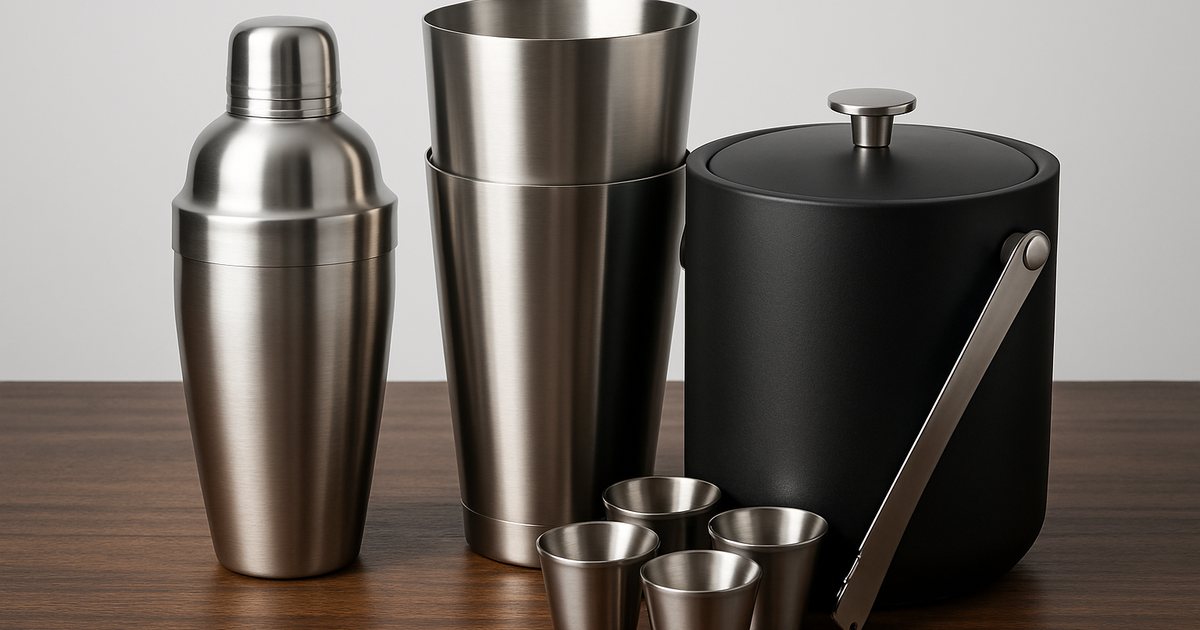
Quick answer: FOB China in 2026, a 550ml cobbler cocktail shaker in 0.6mm 304 stainless costs $2.30-$3.40, a Boston shaker set $2.80-$4.20, a 3L double-wall vacuum ice bucket with lid and tongs $8.50-$14.00, and a 2oz double-wall shot cup $0.85-$1.60. MOQ is 500 pieces per model for engraved branding, 1,000 per custom powder-coated colour. The specification that decides whether your barware survives a commercial bar is not the grade, it is the gauge — 0.6mm minimum, 0.7mm for trade accounts.
We manufacture insulated drinkware and stainless barware in Yongkang, Zhejiang. Barware is a quieter category than tumblers, but the buyers are better: spirits brands running promotional programmes, hospitality groups fitting out venues, and distributors who reorder on a schedule. This guide covers what those buyers ask us and what we tell them.
Who Actually Buys Custom Barware
Four buyer types dominate our barware order book, and they want genuinely different products:
| Buyer | What they want | Typical order | Branding |
|---|---|---|---|
| Spirits & beverage brands | Cobbler shakers and ice buckets as on-trade promotional items | 3,000-20,000 pcs, seasonal | Logo in brand colour, powder coat + engrave |
| Bar & restaurant groups | Boston shakers, 0.7mm, replaceable, unbranded or subtle mark | 500-3,000 pcs, reordered | Small engraved mark or none |
| E-commerce & gifting | Complete bar tool sets in retail gift boxes | 1,000-5,000 sets | Full retail packaging, printed box |
| Hotels & event rental | Insulated ice buckets that keep ice through a service | 500-2,000 pcs | Property logo, muted finishes |
The mistake we see most often is a distributor buying one specification and trying to sell it to all four. A shaker light enough to hit a gift-set price point will be returned by a bar group within a month; a 0.7mm commercial tin priced for trade will lose an e-commerce listing on margin. Pick the channel first, then the specification.
Cocktail Shakers: Boston vs Cobbler vs French
Three shaker architectures exist and they are not interchangeable.
| Type | Pieces | Capacity | Who uses it | FOB price |
|---|---|---|---|---|
| Cobbler | 3 (tin, built-in strainer, cap) | 350ml / 550ml / 750ml | Home users, gifting, hotel minibars | $2.30-$3.40 |
| Boston | 2 (28oz tin + 18oz tin or glass) | 830ml + 530ml | Professional bartenders, cocktail bars | $2.80-$4.20 (set) |
| French / Parisian | 2 (tin + fitted cap, no strainer) | 500-600ml | Design-led venues, presentation service | $3.20-$4.80 |
Cobbler is the volume seller in retail and promotional channels because it is self-contained: the strainer is built into the lid, so the buyer needs nothing else. It is also the easiest to brand, because the flat cap and the tin body both take engraving well. Its weakness is that the cap can seize when cold — a real annoyance behind a fast bar, irrelevant on a kitchen counter. Our 550ml cobbler shaker is the size that outsells the others roughly three to one, because it makes two standard cocktails in one shake.
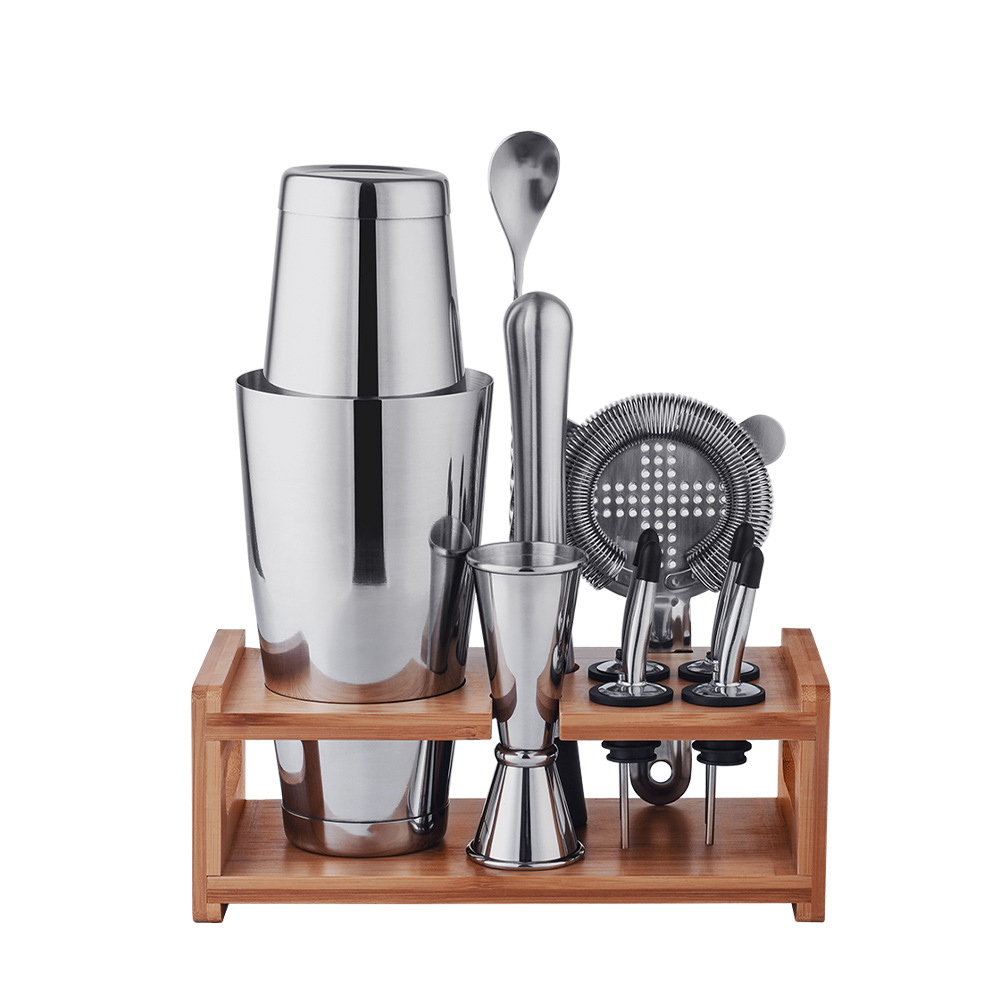
Boston is what working bartenders want. Two tins, nothing to seize, breaks apart with a tap, and cleans in seconds. It needs a separate Hawthorne strainer, which is why it usually ships as part of a set. If you sell to trade accounts, this is your lead SKU — see the Boston shaker bar tool set for the standard configuration.
French shakers sell on looks. They are a two-piece with a fitted cap and no built-in strainer, popular with design-conscious venues. Lower volume, higher price, and worth carrying only if your customers care about presentation.
Gauge Is the Specification That Matters
If you take one number away from this guide, take this one. Steel thickness, not grade, is what separates barware that lasts from barware that comes back.
| Gauge | Feel | What happens in service | Cost delta |
|---|---|---|---|
| 0.4-0.5mm | Light, tinny, flexes under thumb pressure | Dents on first drop; lip deforms and the seal fails permanently | Baseline |
| 0.6mm | Solid, standard retail feel | Survives normal home and gift use indefinitely | +$0.15 |
| 0.7mm | Noticeably heavy, professional | Commercial bar service; the specification for trade accounts | +$0.25 |
The reason a dented shaker is dead rather than merely ugly is mechanical: a shaker seals on the interference fit between two lips. Deform the lip by a fraction of a millimetre and it either will not seal — spraying the bartender — or it will not release. There is no repair. Twenty-five cents at the factory is the whole difference.
On grade: 18/8 and 18/10 both sit in the 304 family, differing in nickel content, and either is fine for barware. What you must avoid is 201 grade, which swaps nickel for manganese to cut cost and rust-spots within months in a wet bar. Ask for a material certificate. Our 304 vs 316 comparison with factory test data covers the corrosion mechanics if you want the underlying numbers.
Not sure which specification fits your channel? Send us your target retail price and your customer type and we will tell you which gauge and finish makes the maths work. Talk to our team →
Ice Buckets: Where Insulation Changes the Category
Ice buckets split cleanly into two products that happen to share a name.
| Single wall | Double wall vacuum | |
|---|---|---|
| Ice retention (3L, lid on, 25°C) | 2-3 hours before significant melt | 12+ hours |
| Exterior condensation | Heavy — needs a cloth or coaster | None; outer wall stays at room temperature |
| Construction | Single 0.6mm shell | 0.5mm inner + 0.6mm outer, evacuated cavity |
| FOB price, 3L with lid | $4.20-$6.50 | $8.50-$14.00 |
| Right for | Budget retail, short-duration display | Bars, hotels, events, outdoor, premium retail |
The condensation point is underrated commercially. A single-wall bucket sweats because its outer surface drops below dew point, which means water on the bar top, on the linen, on the buffet table. A vacuum bucket does not sweat at all, because the outer wall never gets cold. Hotel and event buyers will pay the difference for that reason alone, before you mention ice retention.
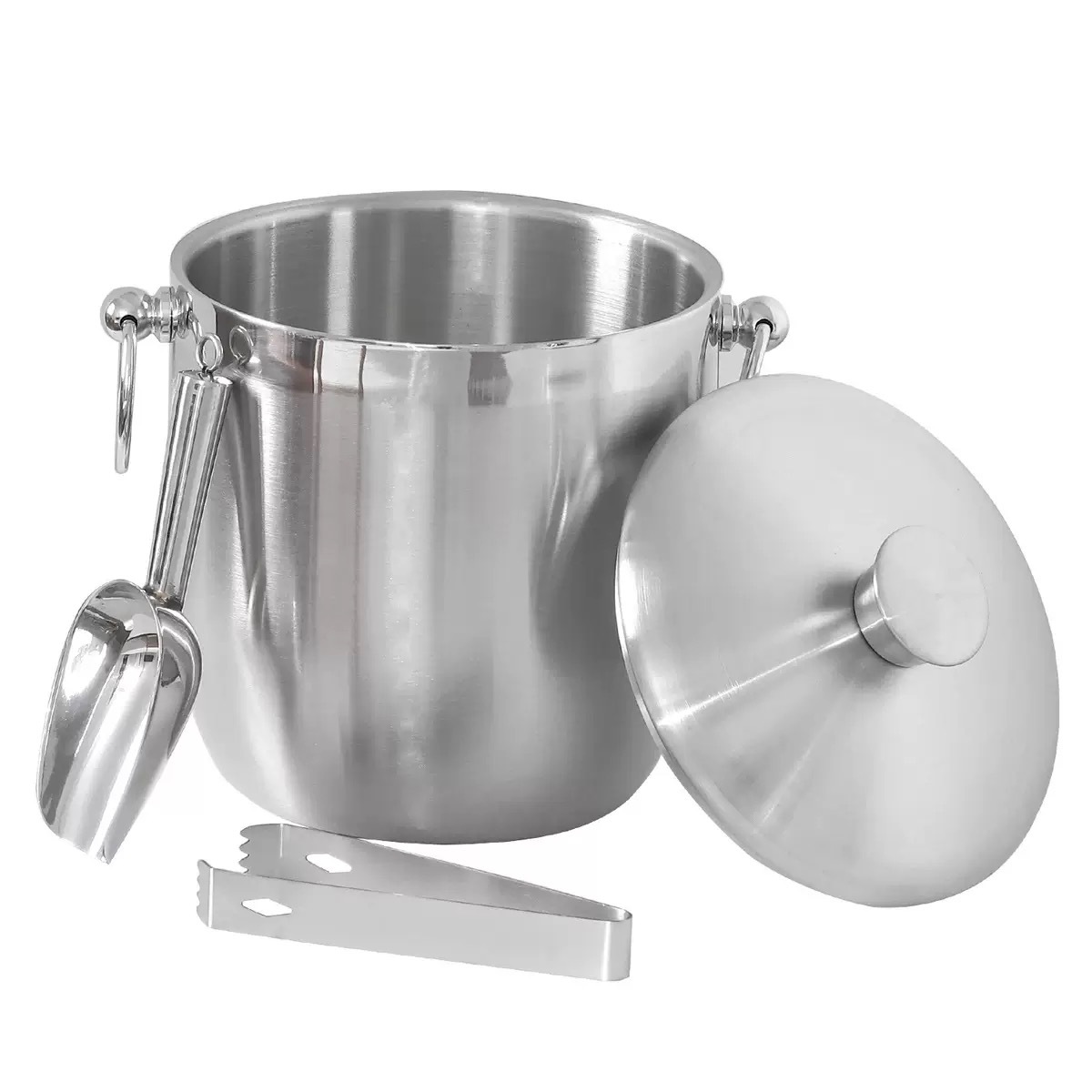
Our 3L double wall ice bucket set ships with lid, strainer insert and tongs, which is the configuration that hospitality buyers ask for — the strainer keeps bottles out of the meltwater. The full ice bucket range runs from 64oz up to a 1 gallon commercial size. If you want the physics behind the retention numbers, we covered it in how to keep ice from melting.
Shot Cups: The Add-On That Lifts Set Value
Stainless shot cups are a small item with a useful commercial role: they raise the piece count and perceived value of a gift set for very little cost. A 2oz double-wall shot cup is $0.85-$1.60 FOB, and adding four to a bar set typically supports $8-$12 more at retail.
- 2oz (60ml) — the standard shot; also the format spirits brands use for tasting programmes
- 3oz (90ml) — doubles as a double-wall espresso cup, which widens the listing keywords considerably
- Double wall keeps the exterior dry and comfortable in the hand and stops the drink warming in a held cup
- Powder coated sets in four to six colours sell better than plain steel in retail, at about $0.35 extra per piece
The shot cup range is available blank for customisers or engraved from 500 pieces.
Branding Methods, Costs and What Each One Survives
| Method | Added cost/pc | Colours | Durability | Best for |
|---|---|---|---|---|
| Laser engraving | $0.15-$0.30 | None (steel tone) | Permanent — it is the metal | Trade accounts, subtle brand marks |
| Screen printing | $0.20-$0.45 | 1-4 spot colours | Good; will wear at 200+ dishwasher cycles | Promotional runs, bold logos |
| Powder coat + laser | $0.60-$1.10 | Body in brand colour, logo in steel | Excellent | Spirits brand programmes |
| Embossing | Tooling $800-$2,500 + $0.10 | None | Permanent | Volume 5,000+, own-brand identity |
Powder coat plus laser is the combination spirits brands nearly always land on: the body carries the brand colour, and the laser burns through the coating to reveal bright steel underneath, which reads as a two-tone logo without any ink. It photographs extremely well, which matters when the item is going into a trade promotion. The trade-off is the 1,000-piece per-colour minimum, because a colour change means purging the coating line. If your colour choices matter more than your budget, read our tumbler colours and finishes guide — the same powder chemistry and cost structure applies to barware.
Pricing Table: What to Budget
| Product | Spec | FOB @ 1,000 | FOB @ 5,000 | MOQ |
|---|---|---|---|---|
| Cobbler shaker 550ml | 0.6mm 304, mirror | $3.40 | $2.60 | 500 |
| Cobbler shaker 550ml | 0.7mm, powder coated | $4.30 | $3.35 | 1,000/colour |
| Boston shaker set | 0.7mm weighted tin + tin | $4.20 | $3.10 | 500 |
| 7-pc bar set + bamboo stand | 0.6mm, gift box | $12.00 | $8.60 | 500 sets |
| Ice bucket 3L, single wall | 0.6mm, lid | $6.50 | $4.60 | 500 |
| Ice bucket 3L, double wall vacuum | Lid + strainer + tongs | $14.00 | $9.80 | 500 |
| Shot cup 2oz double wall | Powder coated | $1.60 | $1.05 | 1,000 |
These are indicative FOB Ningbo prices for 2026 and move with stainless coil pricing, which is the volatile input in this category. They exclude freight, duty and destination charges — our landed cost guide walks through what to add, and note that barware generally classifies under HTS 7323 rather than the 9617 heading that vacuum tumblers use, so the duty maths differs.
Lead Times and the Packaging Trap
- Existing shape + laser engraving: 25-30 days from artwork approval, up to 5,000 pcs
- Custom powder colour: add 5-7 days for colour matching and sample approval
- New tooling: add 25-35 days before production starts
- Printed retail gift boxes: 20-25 days, running in parallel — but only if artwork is committed early
Packaging is where barware orders slip, not production. A seven-piece set needs a printed box with a die-cut insert, and that box has its own supplier, its own proofing loop and its own lead time. We have watched finished shakers sit in our warehouse for three weeks waiting on boxes because the buyer treated packaging as an afterthought. Commit the packaging artwork on the same day as the product artwork. Our packaging options guide has the cost tiers from poly bag to full retail box.
Related Guides
- Wholesale Cocktail Shakers & Stainless Bar Equipment
- Insulated Ice Buckets Wholesale for Parties & Events
- How to Keep Ice From Melting: Double Wall Science
- Insulated Beer Tumblers: Wholesale & Branding Guide
- Drinkware Compliance: FDA, LFGB, Prop 65 & PFAS Test Costs
Get a Barware Quote With Real Numbers
Tell us the channel, the target retail price and the branding method, and we will come back with a specification that works rather than the cheapest thing we can build. We manufacture cocktail shakers and bar tools, insulated ice buckets, shot cups and insulated beer tumblers in-house, so a mixed bar programme ships from one factory on one container.